
08 NOVEMBER
The Software as a Service (SaaS) market has surged over the last five years, and this growth is expected to continue. Venture investments in SaaS businesses have more than doubled during this time, and in 2023, SaaS accounted for 47% of the total investment volume.
Additionally, end users spend more on SaaS than on any other cloud service, and SaaS accounts for over 35% of the corporate IT budget.
So, why do these applications captivate users, and why is SaaS development becoming increasingly popular? In this blog, we’ll explore the benefits, development phases, associated costs, and challenges of building SaaS applications. If you want to learn about the Top SaaS Application Examples and Trending SaaS Solutions of 2024, check them out!
Software as a Service, or SaaS, is a software delivery paradigm in which a provider hosts web applications and makes them accessible to users online, usually via a mobile app or web browser.
A methodical process must be followed when developing a cloud-based SaaS application to provide a reliable, scalable, and easily accessible end product. A detailed instruction to this procedure is provided below:
Step 1: Validating Ideas and Market Research
First, verify the feasibility of your SaaS idea. Then, perform market research to identify your target market, understand their needs, and assess your competitors.
Step 2: Define Your Business Model
Describe your business plan for attracting clients and generating revenue. Choose whether to offer a one-time payment structure, subscription levels, or a freemium approach.
Step 3: Plan Your SaaS Application
Rank your application’s features and functions based on market analysis and product value.
Step 4: Pick Your Technology Stack
Select appropriate technologies for the database, front end, back end, and other crucial elements. Consider factors such as maintainability, scalability, and the availability of development talent.
Step 5: Design UX and UI
Ensuring accessibility, usability, and simplicity are essential elements of SaaS design. When creating a UI/UX design, developing prototypes and wireframes is vital to visualize the interface and map out the user journey. Additionally, one of the significant trends in SaaS development for 2024 is the focus on mobile-first SaaS solutions.
Step 6: Develop the SaaS Application
Based on the intended features and design, start the development process. Use agile approaches to design, test, and improve your application iteratively.
Step 7: Ensure Security and Compliance
Protect user data using strong security measures. Make sure your application meets GDPR and HIPAA requirements instantly.
Step 8: Test Your Application
Conduct thorough testing, including functional, performance, cloud security, and user acceptance testing (UAT), to find and fix issues.
Step 9: Deploy Your Application
You should choose a reliable cloud service provider to host your SaaS system. Start your application and closely monitor its operation.
Step 10: SaaS Product Launch and Marketing
Create a marketing plan incorporating email advertising, social media, content marketing, and SEO to draw customers before the launch.
Step 11: Gather Feedback and Iterate
Actively collect customer feedback after launch through surveys, usability testing, and data analysis. Based on this input, make educated changes and enhancements to your product.
Step 12: Continuous Improvement and Scaling
Keep adding new features and improvements to your program in response to user input and industry developments. Make plans to scale your infrastructure as the number of users increases.
Meticulously following these stages can help you achieve a product that satisfies the needs of your target audience and distinguishes itself in the competitive market. They will lead you through the intricate process of developing a SaaS application from conception to launch and beyond.
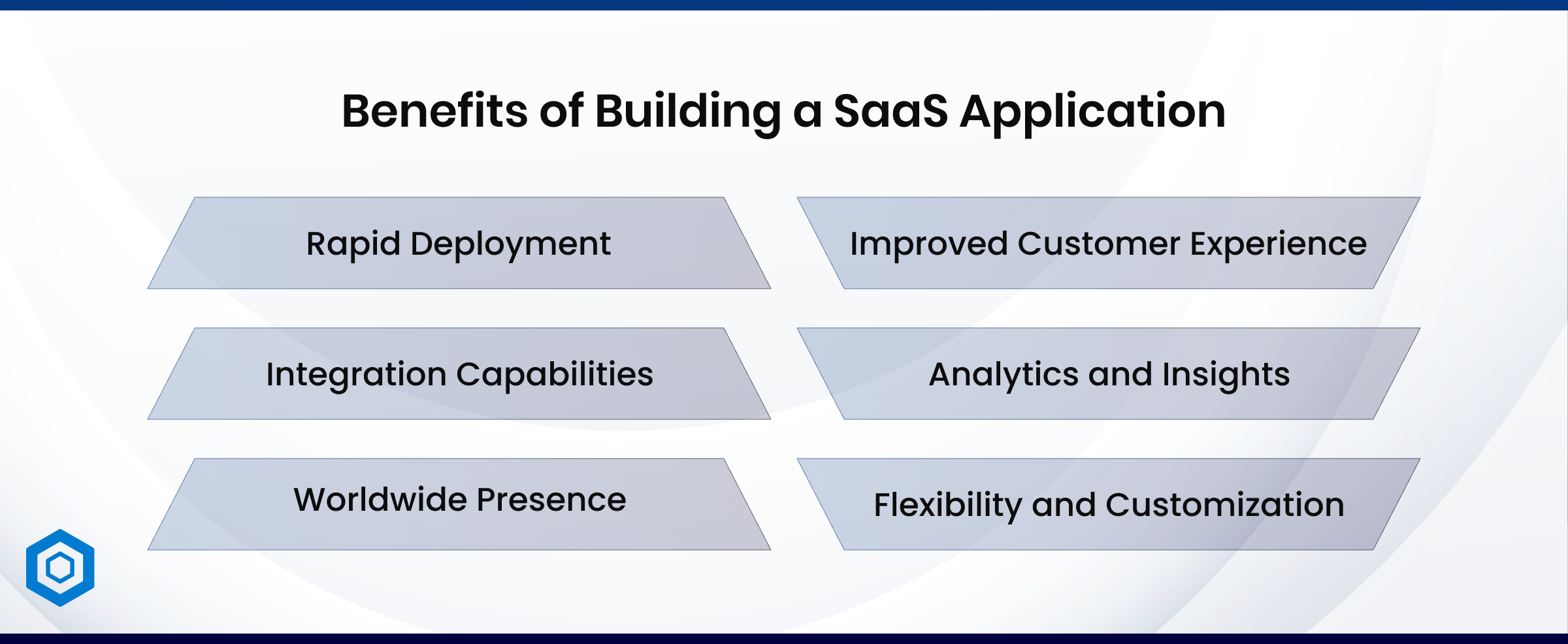
Businesses looking to adopt cloud-based solutions for their software needs might benefit significantly from developing a SaaS application in a cloud environment, especially SaaS organizations that want to handle certain use cases. The following are the main advantages of developing a SaaS application that meets your company’s needs:
SaaS Application Development demands distinct considerations, similar to other software development projects. As mentioned during the testing phase, QA services are critical for SaaS Application Development projects. This emphasis on quality assurance arises due to three main issues listed earlier, which make it evident why QA plays a vital role in SaaS Application Development. In essence, focusing on QA is fundamental for ensuring a smooth, secure, and reliable outcome in every SaaS Application Development project.
Our experience shows that it costs $50,000 to develop MVP software for a SaaS project. The price may even surpass $100,000, depending on the kind of software and the extent of the work.
A minimum viable product should ideally be just that minimal. One essential characteristic anticipated to meet a specific market need should serve as its foundation. However, there are instances when SaaS founders cannot focus their assumptions on a single feature and choose to create more comprehensive functionality and test it with actual users. This affects the development budget, of course.
As the team prepares for the initial release, the number and complexity of features will always determine the final cost. We can predict the cost and duration of developing custom apps with high accuracy and seldom go over budget because most of our projects begin with a discovery phase that includes defining the scope of work.
SaaS Application Development requires a comprehensive approach centered on understanding customer needs. The SaaS Application Development process includes several critical phases: planning, research, defining constraints, designing, developing, implementing, ensuring quality, deploying, and launching the technology stack. Each of these steps in SaaS Application Development plays a key role in creating a successful product.
After the launch phase in SaaS Application Development, continuous improvements are made to achieve a high level of market fit. Effective marketing strategies are then employed to attract and retain customers. To thrive in today’s competitive landscape, the entire SaaS Application Development process must be meticulously executed and aligned with customer expectations.
Hire SaaS professionals from Codeflash Infotech with the know-how, skill, and ability to manage SaaS product development. Due to extensive training and exposure to client projects, we have ensured that our team is knowledgeable in SaaS app development and updated on the newest developments. Our robust SaaS services have the potential to completely transform your company. Contact us to learn more!
The app’s size and complexity will determine this. Developing a high-quality app with a minimal viable product typically takes 6–8 weeks. Simple apps can occasionally be completed in as little as four days.
By subscribing to software, businesses can leverage SaaS development frameworks to build apps from the ground up or as extensions to their current platforms. Under this software model, applications are hosted by a cloud provider.