
19 NOVEMBER
If you have landed on this blog, higher the chances that either you want to build a website for your own business or you want to explore which development method would be the best for your next project.
No matter what your objective is – we understand your needs and have got you covered!
The first thing first – building a website is like creating a big Lego structure, with pieces snapping together to form a beautiful, interactive world. However, when you are building a website, instead of Lego blocks, you have chunks of code.
And to build layers of code that are easy to understand and faster to develop, you need something that helps you manage these pieces. That’s where frontend frameworks come in – they’re like blueprints that make it simple to connect code blocks to create a cohesive structure for your website or app.
Now, when it comes to these blueprints, React and Vue.js are like the rockstars of the frontend development world. These two are often the first choices for developers who want to make smooth, fast, and user-friendly websites.
ReactJS developers and Vue.js development companies use these frameworks to help clients build anything from small websites to large-scale applications. They’re both extremely popular and offer different ways of building and organizing code, but each has its unique style and approach.
Now, you might wonder, “If they both help build websites, why choose one over the other?” Good question!
The choice between React and Vue.js is a bit like choosing between two different but equally popular video games: each has its rules, levels of difficulty, and fanbase. Some people prefer one because it’s easier to get started, while others like the depth and flexibility the other offers.
So, in this blog, we’re going to explore what’s the difference between React and Vue.js and which frontend framework you should choose for your website.
So, let’s get started without any further delay!
Before we find out the features, advantages, and trade-offs of React vs. Vue.js, let’s take a quick look at what React and Vue.js actually are.
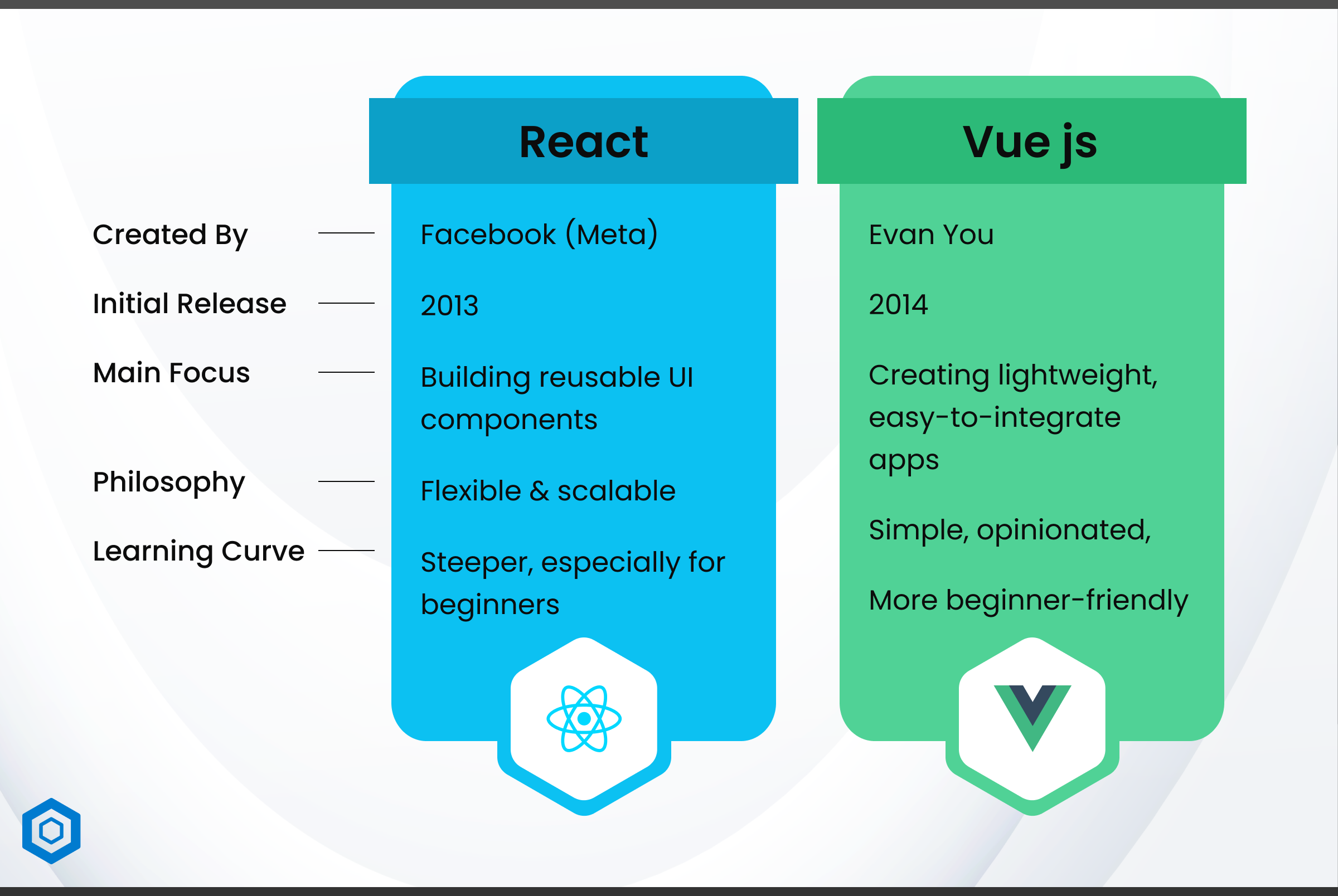
React is a JavaScript library used for building user interfaces (UI) for web and mobile applications. React was created and launched by Facebook (now Meta) in 2013 to help developers create complex user interfaces in an efficient way.
React is all about flexibility as it lets developers decide how they want to structure their projects, which libraries to use, and how to manage data flow within the app.
Vue.js, on the other hand, is a progressive JavaScript framework created by Evan You in 2014. Unlike React, Vue.js was designed with a different philosophy in mind: to be simple, lightweight, and easy to integrate into any existing project. It allows developers to build powerful apps, but with a much simpler learning curve.
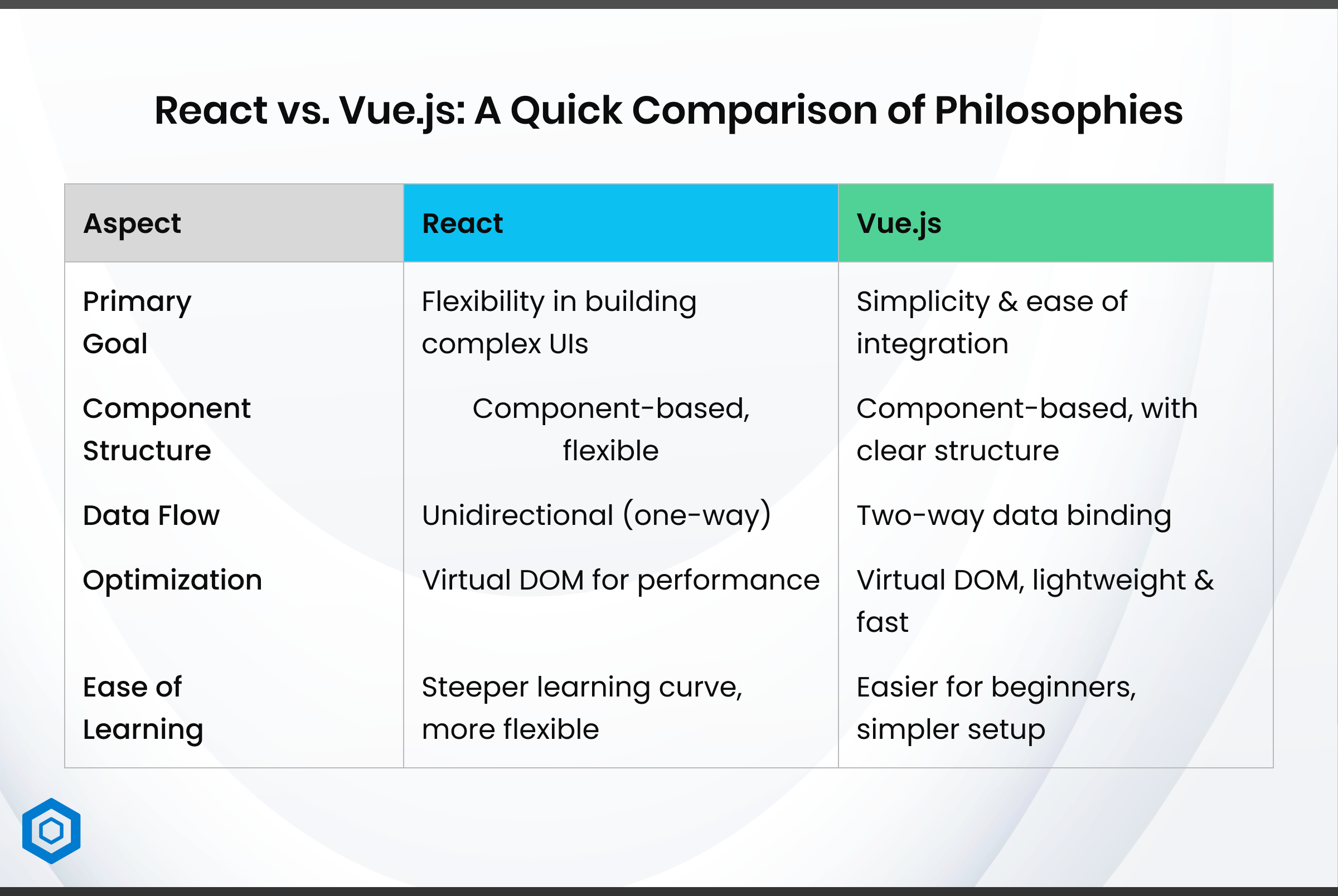
One key feature that sets Vue apart is its two-way data binding. In simple words, it means that any changes made to the user interface (UI) are automatically reflected in the data model and vice versa. This makes it easy to keep everything in sync, especially in real-time applications like chat apps or dashboards.
Now that you have got quite a fair idea about what React and Vue.js, let’s have a quick look at the core functionality and philosophy differences in React vs Vue.js.
When you start using React for your project, you will experience that its primary goal is to make developers’ lives easy by giving them an ability to build dynamic and efficient user interfaces.
Here are some key functionality and component of React –
Next characteristic of React is unidirectional data flow. So what does this mean? It means that in React, data flows in a single direction (from parent components to child components).
This single direction flow of React makes it easier to track changes in your app’s state and understand how different pieces of data interact with each other.
The tricky part here? This single directional flow requires a bit more effort to set up (especially when using libraries like Redux for state management) but it allows for better control and predictability, especially in complex applications.
Last but not least, React works with virtual DOMS. Now what does these virtual DOMS mean? It means that React creates a virtual version of the DOM in memory as they are faster to update.
Now when you make changes in the virtual DOM, React compares the new version of the Virtual DOM to the previous one and only updates the parts that have changed.
So if you are working for a web or app that has lots of dynamic content – React is definitely a good choice as a development method.

Compared to React, Vue.js takes a different approach. The primary goal of Vue.js is to make web development simpler and more approachable for developers of all skill levels – be it beginners or experienced.
Now that we’ve understood the core philosophy and functionality differences of React and Vue.js, it’s time to have a look at how they are different when it comes to performance.
Let’s explore that in the upcoming section.

Performance is a big consideration when building modern web applications. So, let’s find out who wins this battle of performance.
Here’s a quick comparison of both the platforms in various aspects –
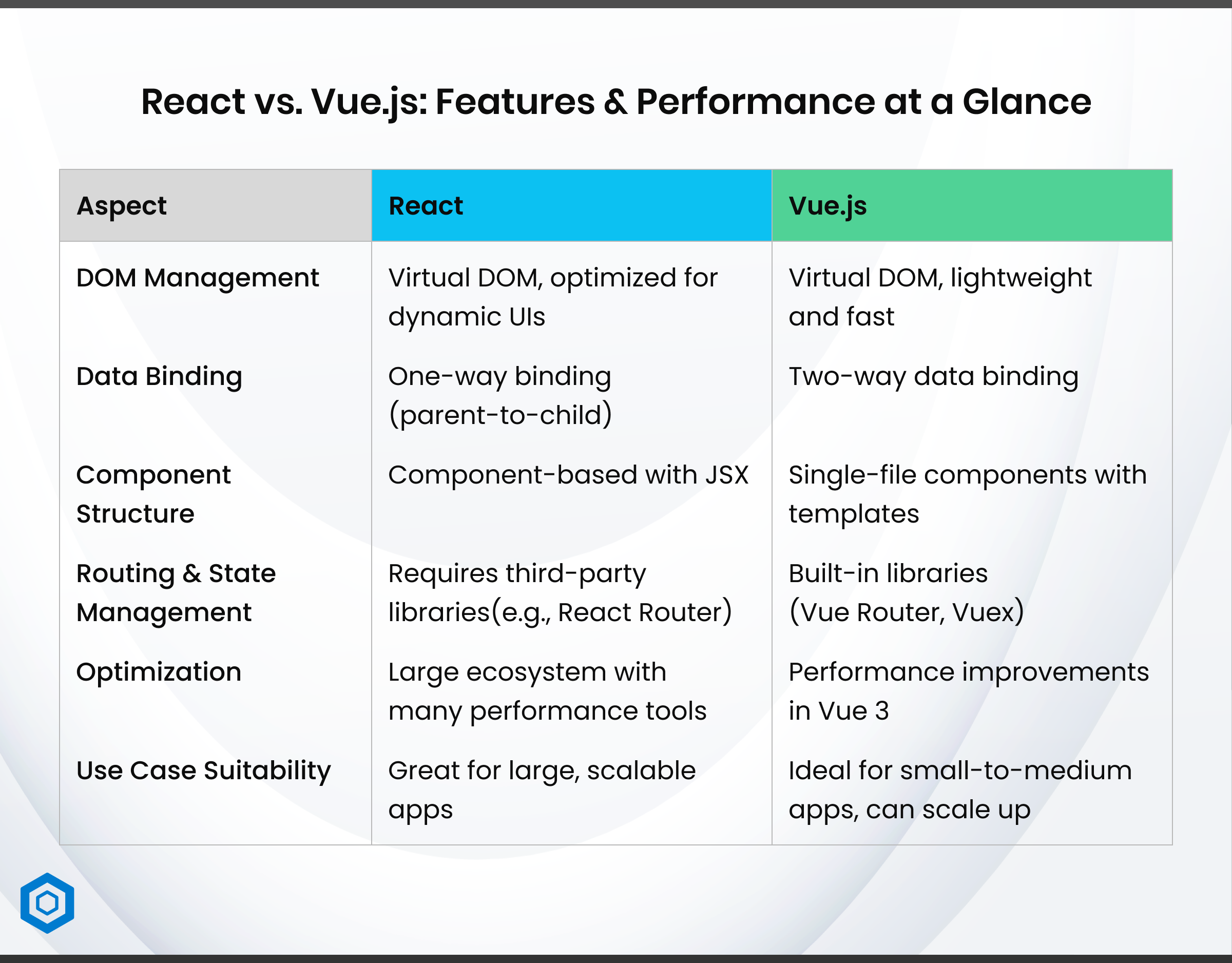
React vs. Vue.js: Features & Performance at a Glance
Let’s summarize the features and performance aspects of React vs Vue.js in a table for quick reference:
There’s no doubt that a strong community and a well-developed ecosystem can provide more resources, support, and tools, helping you build faster and tackle issues more easily.
Let’s have a look at the ecosystem and community support of React Vs Vue.js –
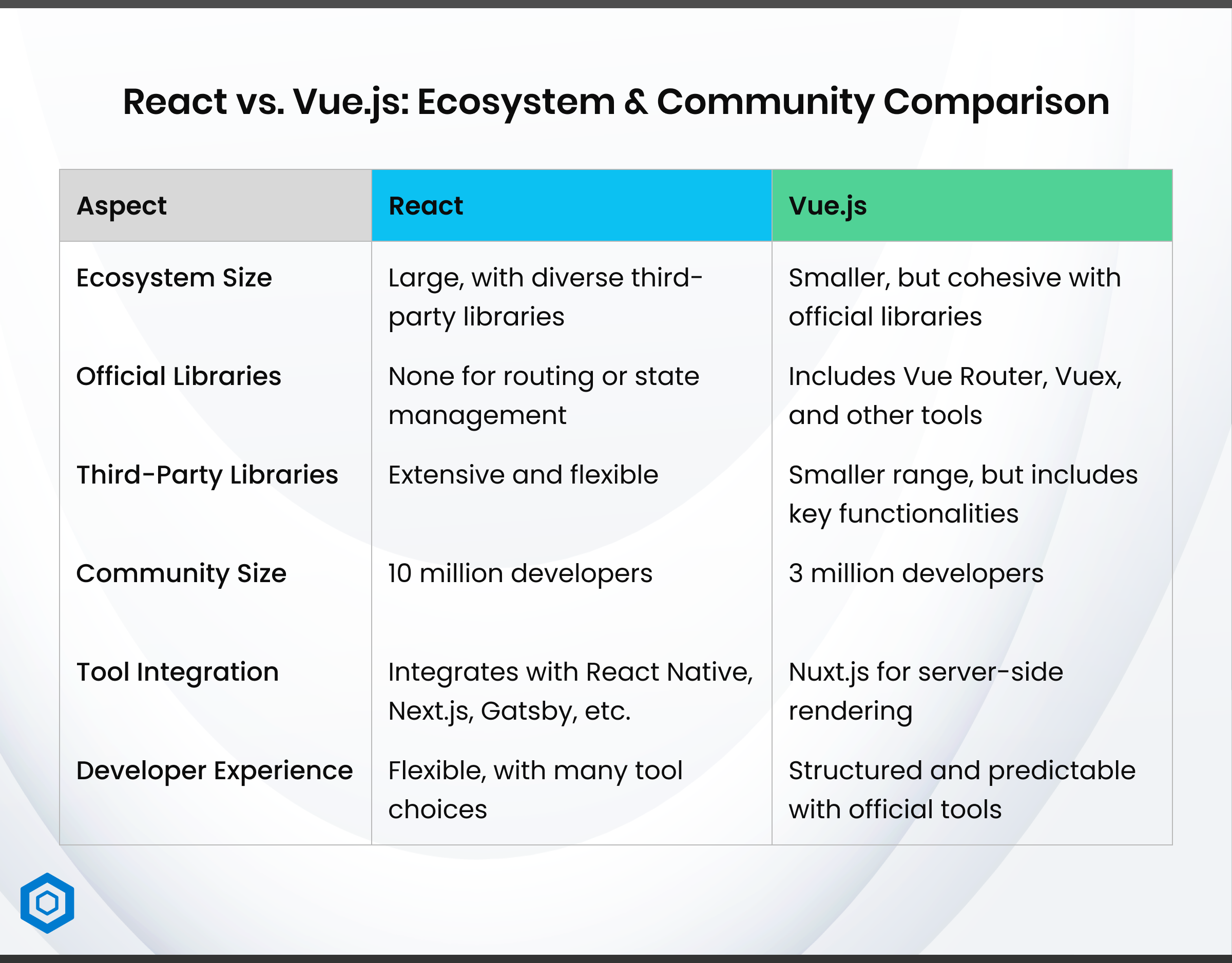
As React has been around since 2013 and is maintained by Meta, they had a lot of time in growing a huge ecosystem. When we talk about the ecosystem of React, it has thousands of libraries and tools to extend its capabilities.
Plus, the React community is also very large, consisting of 10 million developers worldwide, making it easier to find resources, tutorials, and support.
Vue is known for its cohesive, straightforward ecosystem, especially useful for those who want a smooth, integrated experience without a lot of third-party tools. Vue includes official libraries like Vue Router and Vuex, offering everything you need for routing and state management right out of the box.
Its community, while smaller at about 3 million developers, is active, supportive, and highly engaged.
Here’s a quick look at how React and Vue compare:
So the big question comes now: what to choose for your next project – React or Vue.js? Let’s find out that in the next section!
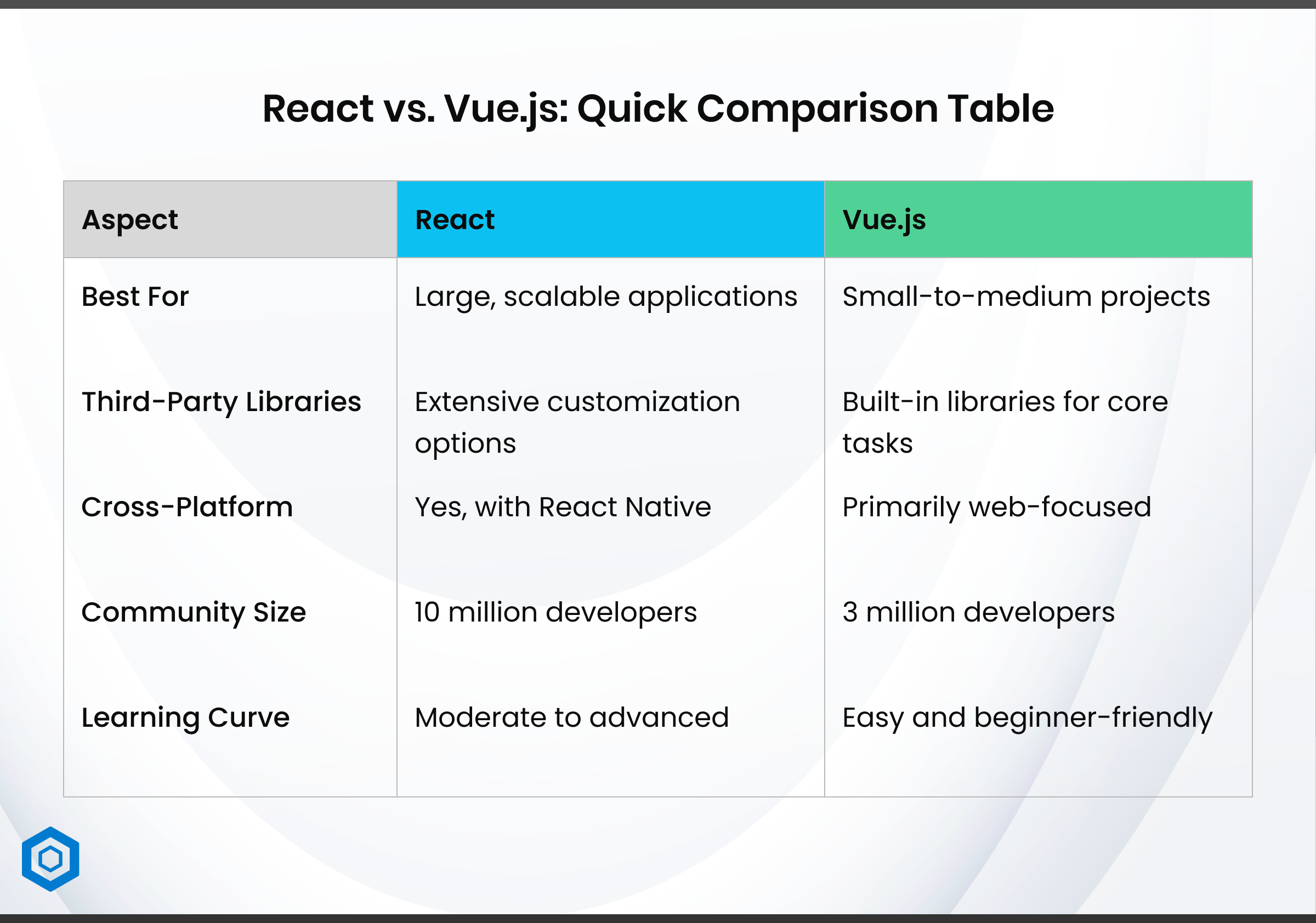
Deciding between React and Vue.js can be really tricky sometimes but let us tell you that it all depends on your project’s needs and your development priorities.
Consider below mentioned points while deciding between React Vs. Vue.js –
Choosing between React vs. Vue.js can be confusing sometimes but that doesn’t need to be the case when you want to hire a web development company for your next project.
At Codeflash infotech, we have helped multiple businesses build their custom web and apps to help them achieve their unique business goals.
If you are looking for the best web development company for your React or Vue.js development, our team of experts are all ready to help you achieve your goals. You can explore all the projects that our team has worked on by having a look at our portfolio!
Get in touch with our team today by filling in this form or send us an email at contact@codeflashinfotech.com to discuss your requirements.