
24 FEBRUARY
Modern businesses are under constant pressure to innovate and stay competitive. Many still rely on legacy applications — software systems designed years ago, often running on outdated hardware or technology stacks. While these applications continue to support essential business functions, they slow growth, inflate costs, and limit scalability.
Migrating legacy applications to the cloud is no longer optional — it’s a strategic move to unlock agility, security, and new business opportunities. In this guide, we’ll explore how to execute a successful legacy to cloud migration, step by step, with proven cloud migration best practices.
Quick Stat: According to Flexera’s State of the Cloud Report, 94% of enterprises now use cloud services, yet legacy systems remain the #1 barrier to full digital transformation. This guide helps you bridge that gap.
A legacy application is typically a system built using older programming languages or platforms that may no longer support modern business requirements. These systems are often deeply embedded in business operations, which makes migration challenging but also essential. Common examples include:
Legacy systems often face compounding challenges that erode business performance over time:
High Maintenance Costs
Aging infrastructure demands expensive specialists and spare parts that are increasingly scarce.
Slow Performance
Outdated systems struggle to handle modern workloads, impacting employee productivity and customer experience.
Security Vulnerabilities
End-of-life software no longer receives security patches, creating critical compliance and breach risks.
Integration Gaps
Legacy apps struggle to connect with modern APIs, SaaS tools, and cloud-native services your business relies on.
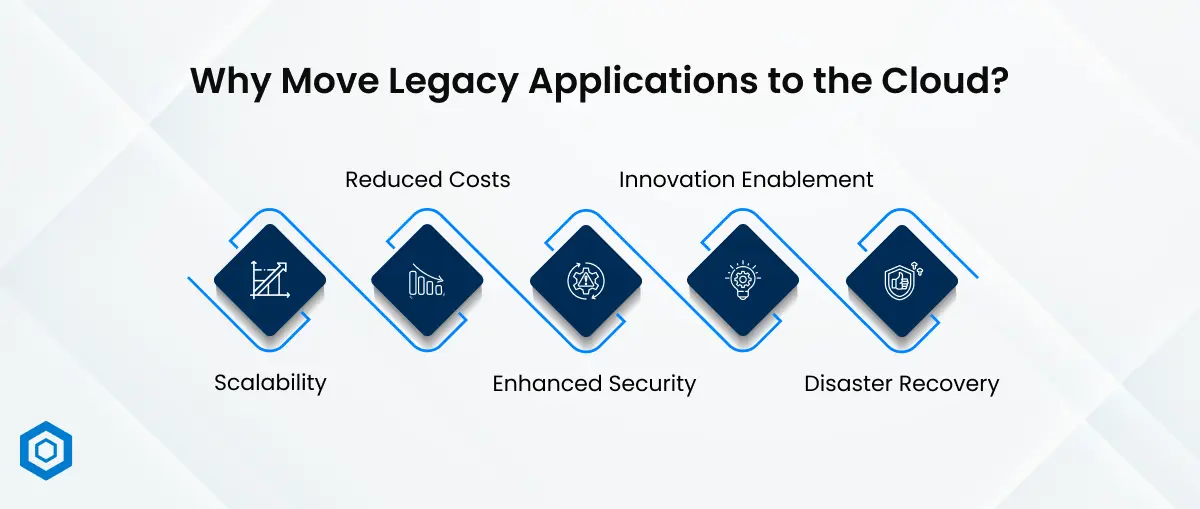
Businesses that adopt a structured cloud migration strategy for legacy applications gain lasting competitive advantages. Here’s what you unlock:
Scalability
Easily scale resources up or down based on real-time business demand.
Eliminate the limitations of static servers with flexible, on-demand infrastructure.
Reduced Costs
Minimize hardware, licensing, and maintenance expenses.
Pay only for what you use with a flexible pay-as-you-go pricing model.
Enhanced Security
Protect sensitive data with enterprise-grade encryption and monitoring.
Built-in IAM, compliance frameworks, and SIEM tools strengthen your security posture.
Innovation Enablement
Accelerate innovation with access to AI, analytics, and automation tools.
Leverage ML services, serverless computing, and APIs to build smarter solutions.
Disaster Recovery
Ensure business continuity with automated backups and rapid failover systems.
Geo-redundant storage and DRaaS minimize downtime and data loss.
Global Reach
Deploy applications closer to users across multiple regions worldwide.
CDNs and multi-region infrastructure deliver low-latency, high-performance experiences.
Leading cloud providers like Amazon Web Services (AWS), Microsoft Azure, and Google Cloud each offer dedicated migration programs and toolsets to accelerate the process. Explore our cloud solutions services to see how we help clients leverage these platforms.
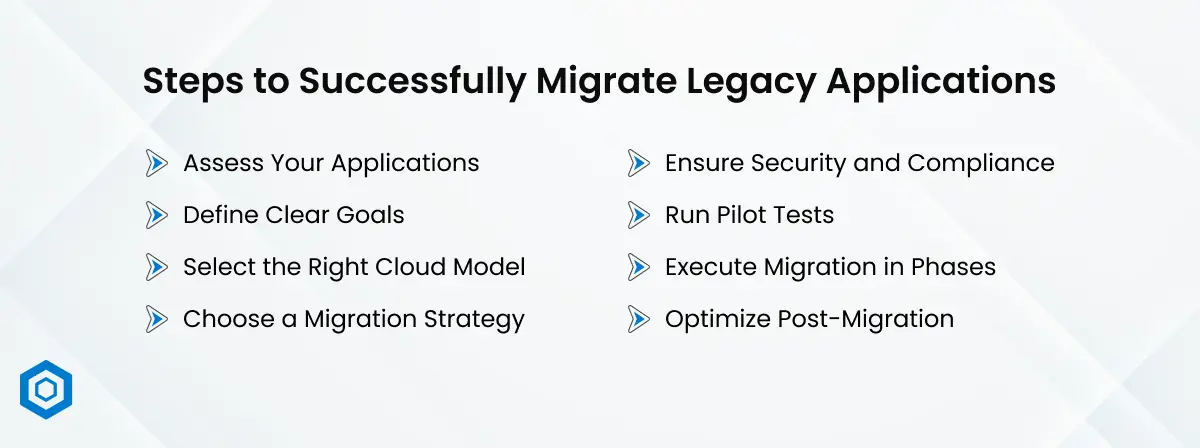
Executing a successful migration requires careful planning. Follow this legacy to cloud migration guide:
Start by reviewing all existing applications:
This analysis helps prioritize which applications to migrate first.
Set measurable objectives for migration:
Clear goals help align your cloud migration best practices with business outcomes.
Your choice of cloud environment depends on security, compliance, and scalability requirements:
Different applications may require different approaches:
Lift-and-Shift (Rehosting) | Move applications as-is to the cloud. Fast but may not leverage cloud features fully. |
Refactor / Re-architect | Modify the application to take advantage of cloud-native features. |
Rebuild | Completely rebuild applications on cloud-native frameworks. |
Replace with SaaS | Swap legacy systems for cloud-based solutions. |
Cloud migration must address security risks:
Before migrating everything:
Avoid migrating all applications at once:
After migration:
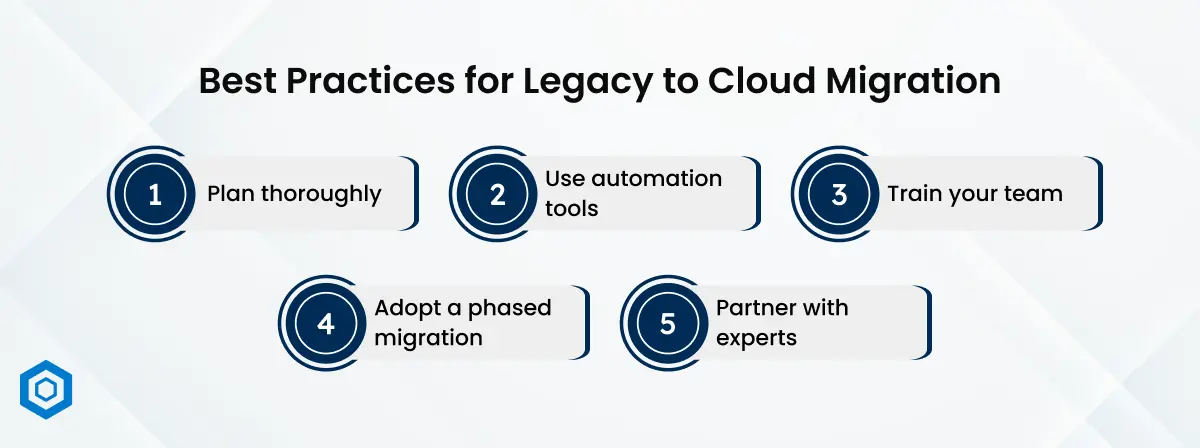
To ensure success:
Integration Issues: Use APIs or containers to connect old systems to new cloud services.
Downtime Risks: Schedule migrations in phases and use failover strategies.
Data Security Concerns: Encrypt data, monitor access, and apply cloud-native security tools.
At Codeflash Infotech, we specialize in helping businesses migrate legacy applications safely, efficiently, and with minimal disruption. Our end-to-end cloud migration services cover the full journey:
Tailored cloud migration strategies for legacy applications of any complexity
Full application assessment, dependency mapping, and migration planning
End-to-end project management, testing, and phased deployment
Security hardening, compliance alignment (GDPR, HIPAA, SOC 2)
Post-migration support, cost optimization, and continuous monitoring
DevOps & CI/CD pipeline setup for accelerated delivery post-launch
We have helped clients across fintech, healthcare, SaaS, eCommerce, and logistics modernize legacy systems without business disruption. Read verified client reviews on Clutch.co or explore our project portfolio.
Migrating legacy applications to the cloud is a strategic investment that boosts efficiency, security, and growth potential. By following this legacy to cloud migration guide and implementing cloud migration best practices, organizations can modernize without disrupting business operations.
Let Codeflash Infotech help you turn your legacy systems into modern, cloud-ready applications that drive innovation and growth.
It is the process of moving old software systems from on-premises infrastructure to the cloud to improve performance, security, and scalability.
To reduce costs, increase flexibility, enhance security, and enable modern technologies like AI and automation.
Common challenges include data security, system integration, downtime, and technical complexity.
It depends on application size and complexity. Small projects may take weeks, while larger systems can take months.
The best strategy depends on your business needs. Common options include lift-and-shift, refactoring, rebuilding, or replacing with SaaS.