
26 MAy 2023
In today’s digital age, the proliferation of technology has led to a significant increase in the number of online food delivery options available to consumers. Consequently, customers often need help with choosing the best service that caters to their needs. In this blog post, we will delve into the realm of food delivery apps vs food aggregator apps, highlighting their differences and benefits.
By examining the differencess between these popular food delivery apps in usa, we aim to assist you in making an informed decision about whether food delivery apps or food aggregator apps are better suited to your preferences and requirements.
When developing a food delivery app, it’s essential to understand the dynamics of the Food Delivery apps Vs Food Aggregators Apps landscape. Food delivery apps serve as online platforms that seamlessly connect customers with a wide array of restaurants, allowing them to order food and have it conveniently delivered to their desired location. These apps provide a user-friendly experience, enabling customers to browse menus, select items, complete payments within the app, and track their deliveries in real time. Collaborations with local restaurants ensure a diverse range of cuisine options, while additional features such as user reviews, ratings, loyalty programs, and customization options enhance the overall user experience.
In terms of logistics, food delivery apps employ various delivery methods. Depending on the business model, they may operate their own fleet of drivers, partner with third-party delivery services, or rely on the restaurant’s existing delivery infrastructure. While some apps charge customers delivery fees or service charges, others leverage free delivery or promotional offers to incentivize ordering.
Building a food delivery app presents an exciting opportunity, given the growing demand for online ordering and home delivery services. By offering convenience and accessibility, your app can enable customers to enjoy their favourite restaurant meals without leaving their homes or workplaces. To ensure success, it’s crucial to establish partnerships with local restaurants and design a Food delivery app with a user-friendly interface that includes features like real-time tracking, secure payment options, and personalized recommendations. Implementing efficient delivery logistics and considering cost-effective pricing models will also be key factors in building a successful food delivery app.
Now that we’ve explored the dynamics of the food deliverymarket and the essential elements to consider, you can embark on the journey of creating food delivery app that caters to the needs of both customers and restaurants alike.
When comparing top Food Delivery apps Vs Food Aggregator apps, food aggregator apps are vital as online platforms that connect customers with diverse food options from various restaurants in a specific area. These apps offer customers the convenience of browsing menus, placing orders, and making payments directly within the app. Additionally, they may incorporate features such as user reviews, ratings, order tracking, and loyalty programs to enhance the user experience.
Unlike food delivery apps, food aggregator apps do not handle the delivery process themselves. Instead, they rely on restaurants or third-party delivery services to fulfil the orders. Depending on the platform, restaurants may be charged commission fees for each order made through the food aggregator app. Alternatively, some apps may adopt subscription models or other payment structures.
The rise in popularity of food aggregator apps can be attributed to their ability to provide customers with a hassle-free way to explore and order from multiple restaurants without the need to switch between various apps or websites. These apps also serve as a platform for smaller, local restaurants to expand their reach and compete with larger chain establishments.
Considering the differences between Food Delivery and food Aggregator apps, it is important to understand the unique features and advantages of each when deciding which option best aligns with your specific requirements and preferences.
Let’s take a closer look at how food delivery apps function, breaking down the process into simple steps:
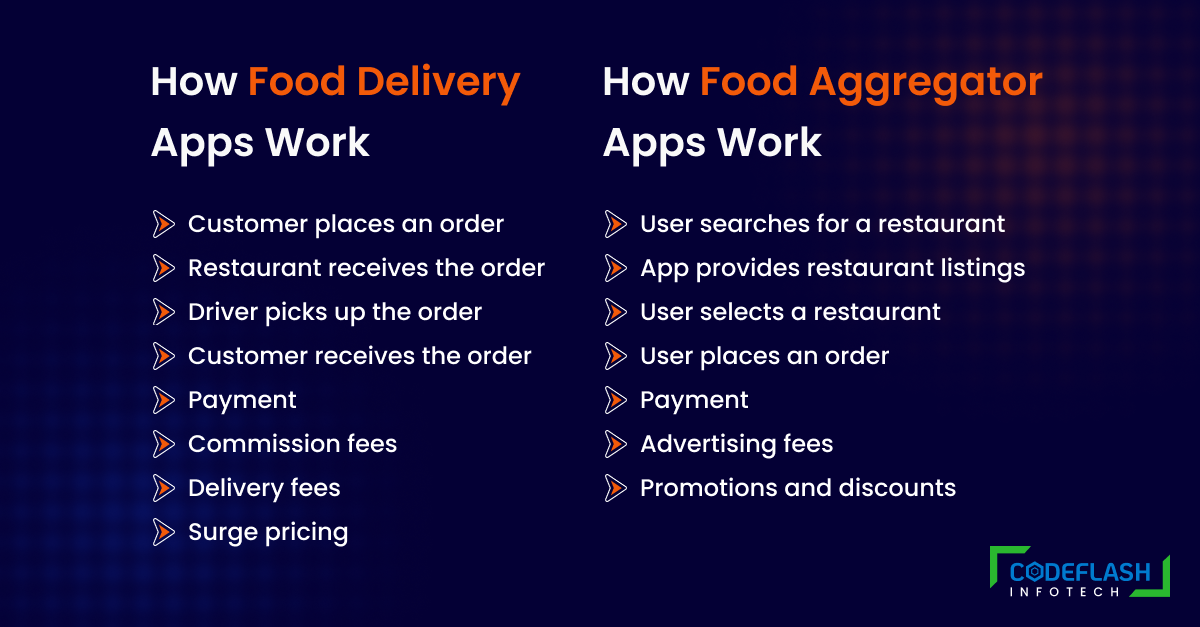
Food aggregator apps work by providing a platform that allows users to browse and discover local restaurants and their menus. Here is a step-by-step overview of how food aggregator apps work:
There are several pros and cons of using food delivery apps.
Pros:
Cons:
There are several pros and cons of using food aggregator apps.
Pros:
Cons:
Here is a comparison table between food delivery apps and food aggregator apps:
| Category | Food Delivery Apps | Food Aggregator Apps |
| Definition | Online platforms that deliver food from restaurants directly to customers | Online platforms that provide listings of restaurants and menus, but do not handle food delivery |
| Business Model | Make money by charging commission fees on orders, delivery fees, and surge pricing | Make money by charging commission fees on orders and advertising fees to restaurants |
| Customer Experience | Customers can order food directly through the app and track the delivery in real-time | Customers can browse restaurant listings and menus, but must order directly from the restaurant or through a third-party delivery service |
| Restaurant Partnerships | Partner with restaurants to offer delivery services directly to customers | Partner with restaurants to list their menus and offer promotions to customers, but do not handle delivery |
| Delivery Logistics | Manage a network of drivers to deliver food from restaurants to customers | Do not handle delivery logistics, but may partner with third-party delivery services to offer delivery options |
| Examples | UberEats, DoorDash, GrubHub | Yelp, Zomato, TripAdvisor |

The rise of online Food Delivery Vs Food Aggregator has transformed how we order restaurant meals. These two app types offer remarkable convenience and simplicity in food ordering, yet they possess distinct advantages. To make an informed choice, it is crucial to consider your specific requirements. Whether you opt for a food delivery app or a food aggregator app, both alternatives offer swift and effortless access to a wide range of delectable dining options available in your vicinity.
In addition to exploring the differences between food delivery and food aggregator apps, it is worthwhile to delve into the Online Food Delivery Business Model: A Comprehensive Guide By understanding the intricacies of this model, entrepreneurs can make informed decisions when venturing into the online food delivery industry. Furthermore, incorporating appropriate transition words aids in seamlessly presenting the information and guiding readers through the various aspects of these apps and the business model.
So are you looking for food delivery app development company or a dedicated developers to develop a mobile app? Let’s connect with our sales team for further discussion.