
15 JULY
In today’s data-driven world, managing knowledge efficiently is no longer a luxury but a necessity. Organisations, huge ones, tend to produce massive amounts of information every day. It is in this aspect of finding information that can be acted upon amidst this data jungle that AI knowledge management converts it into a transformative process. AI is significantly impacting knowledge management, with the global market expected to reach $62.4 billion by 2033. Artificial intelligence and knowledge management integration have restructured the way businesses store, access, analyze, and use information.
Knowledge management (KM) is a method of managing information assets effectively, employed to capture and organize information, share and utilize knowledge, and improve performance. The KM systems of the past were based on structured data and curated by human beings. Nevertheless, these strategies were often inadequate when it came to scaling with unstructured data, such as email, social media content, and meeting transcripts.
Here’s where AI and knowledge management come together. Natural language processing (NLP), machine learning (ML), and semantic search are AI tools that have recently been integrated into knowledge management (KM) systems, enabling software robotics to automate data classification and enhance the accuracy of search, while also anticipating user needs.
Curious about our past work in AI knowledge management? View our complete portfolio
Want to explore how AI can revolutionize your knowledge systems? Email us
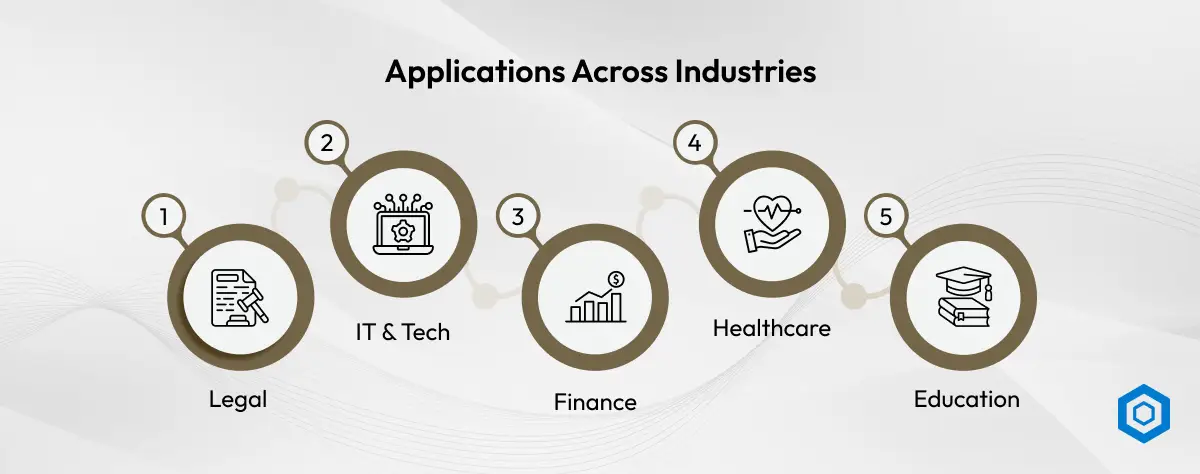
The power of knowledge management and artificial intelligence spans multiple industries:
There are several steps to building effective utilization of artificial intelligence in knowledge systems:
With the continued development of AI, the use of AI in KM will also advance. More friendly ways to engage people, such as voice search, stronger personalization, and pushing different knowledge to users, should be expected. In the final analysis, AI, combined with knowledge management, is a crucial component for organizations that do not want to fall behind in the rapidly evolving world.
Ready to implement AI in your enterprise knowledge strategy? Contact Us!

AI can assist with better knowledge management (KM) through data tagging automation, improved search performance, and understandable recommendations, as well as insights derived from unstructured information.
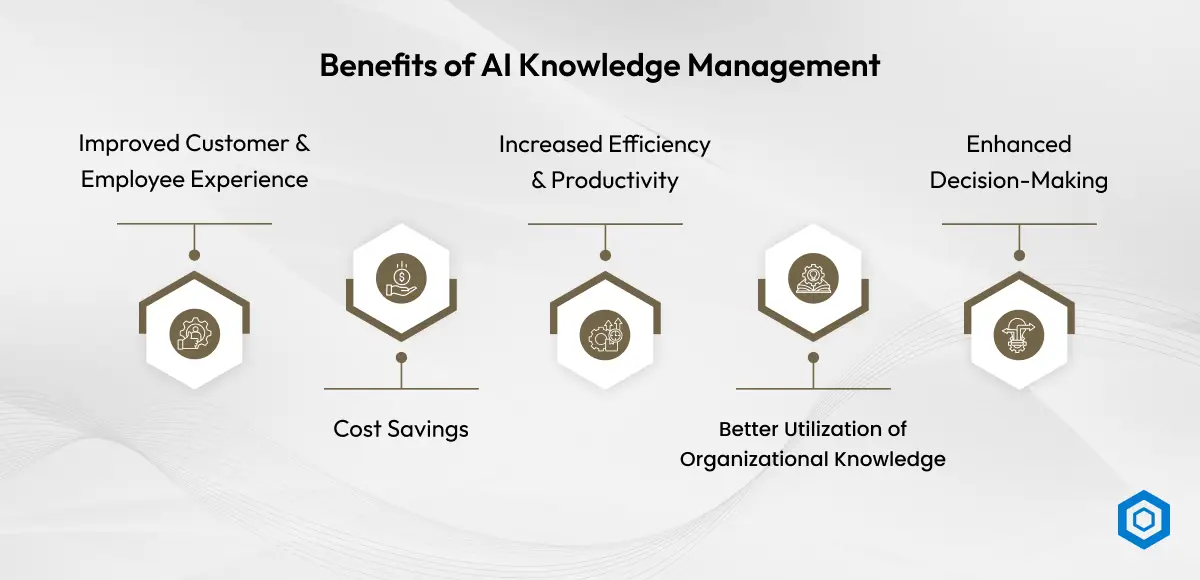
Among the benefits are accelerated decision-making, increased productivity, effective cost management, enhanced employee experience, and streamlined organizational knowledge.
Yes, with the help of NLP and machine learning, AI can read emails, documents, chats, and other forms of communication, process, and extract useful information.
Some critical industries that have seen tremendous gains with the application of AI include healthcare, finance, education, and the IT industry, based on the system’s ability to manage and access large amounts of data.
AI does not substitute human beings but complements them. It automates repetitive tasks and provides rational assistance, allowing people to focus on strategic tasks.