
12 September
The world of healthcare is changing as we speak, and “AI in hospital management” as a concept has become a key driver in redefining the way hospitals are run, treated, and interact with patients.
A Statista analysis estimates that the global market for AI in healthcare will be worth more than “$187 billion by 2030.” That is how “AI hospital software” can improve efficiency at a hospital: precision and patient outcomes.
This surge is not just about replacing manual processes with machines. It’s about introducing “intelligent systems” capable of “predictive analytics in healthcare, AI-driven hospital operations, and real-time decision-making, all within complex hospital environments.
For hospital administrators, clinicians, and IT leaders, embracing “artificial intelligence in hospital management” is no longer a luxury; it has become a necessity for sustainable operations and quality care.
In this blog, we’ll explore the benefits of AI in hospital management systems, address the challenges of AI in hospital management, and dive into real-world use cases where AI healthcare management is making a measurable difference.
AI in Hospital Management refers to the use of machine learning technology to support, automate, and potentially enhance various aspects of hospital operations and patient care.
The former relate to administrative issues (scheduling of appointments, billing, inventory, etc.) as well as the latter that refer to medical industry tasks (support for diagnosis, monitoring and management of patients, personalisation of treatments, etc.).
At hospitals, healthcare AI technology can analyse vast amounts of data (like patient records, lab results, and real-time vital signs) to assist doctors in making decisions more quickly and with greater accuracy.
It also facilitates resource sharing, predetermines patient admission times, and enhances the system’s overall efficacy, ultimately leading to improved patient outcomes and reduced costs.
AI can help oversee hospital operations by managing routine administration, including booking appointments, running billing, and maintaining patient records.
This decreases the potential for mistakes made with hands, saves time and allows the hospital employees to focus on more direct patient care. It also supports diagnosis by scoring scans and automatically reporting to enable quicker, better decision-making.
It would also help the hospital to better manage resources by predicting patient arrival, ICU attendance and emergency calls. It can interpret such patient data for personalised care and offer a remote monitoring service to continue care. But most importantly, it is contributing to improved operational efficiency and patient care.
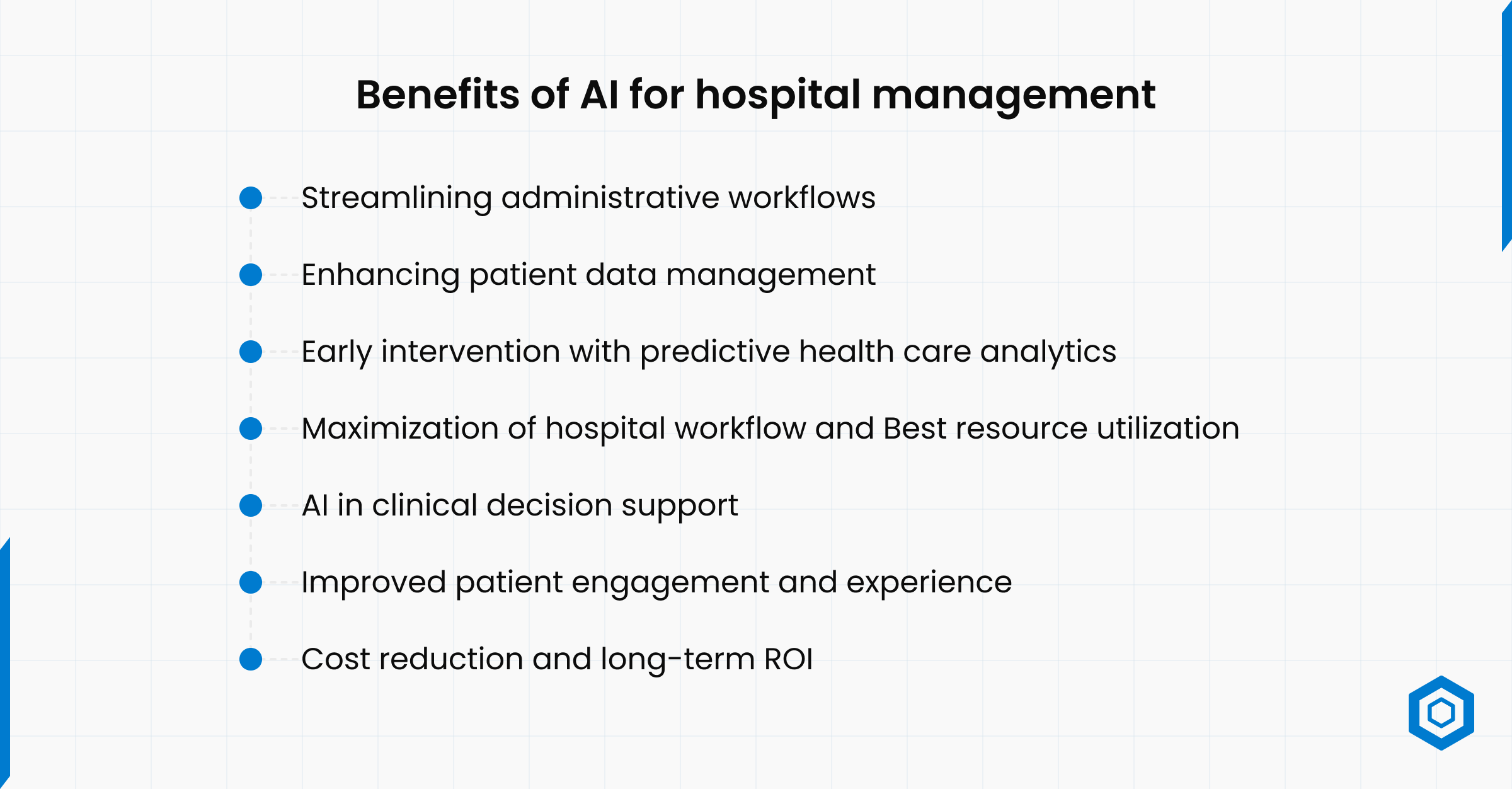
Artificial intelligence has transitioned from clinical diagnosis, and it is now quite integrated in the functioning of hospitals. From front-desk automation to potential explorations into cutting-edge analytics, AI in hospital management provides a foundation for several strategic advantages.
1. Streamlining Administrative Workflows
The modes of government tend to be the humdrum, the distraction from the busyness of life. AI makes it possible to automate repetitive activities, increasing accuracy and speed.
Key efficiencies include:
AI-powered hospital management enables employees to leave paper-based processes behind and free up time for their patients, which in turn leads to more efficient processes and better service provision.
Modern hospitals create and keep track of vast volumes of clinical data. AI tools make this data manageable, accessible, and meaningful in real time.
Also, in the patient data management field, hospitals can achieve this with AI by:
The hospitals can do the following with AI in patient data management:
The result is faster, data-driven decisions and reduced diagnostic delays.
3. Early Intervention with Predictive Health Care Analytics
There are risks that A.I. models can see, and that can be invisible to a clinician. Drawing from patterns in historical data, they provide a potent form of insight into the future of hospital operations.
Hospitals can now use predictive analytics in healthcare:
When operations run smoothly, clinical outcomes and revenue both see a lift.
Doctors today are overwhelmed with data and tight timelines. AI helps by giving you real-time, evidence-based information to assist you in making decisions.
In AI healthcare management, Clinical Decision Support Systems (CDSS) can:
AI doesn’t replace clinical expertise, but it enhances it, especially under pressure.
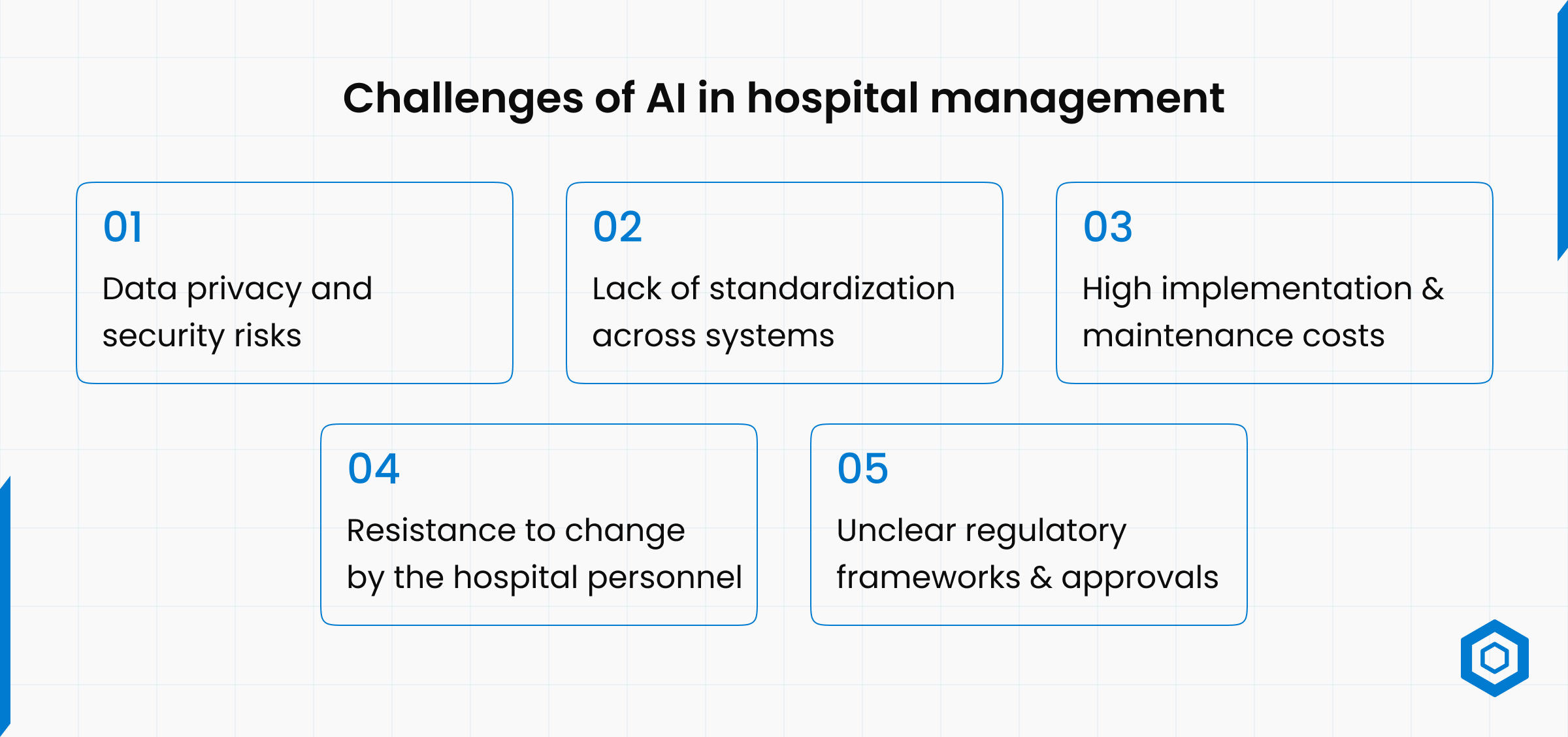
From ethical dilemmas to disruptions to key infrastructures, here are some of the hurdles that organisations will need to clear to wield AI in hospital management to best effect. Here are the challenges of AI in hospital management systems and why overcoming them will be the key to its success in the long run.
1. Data Privacy and Security Risks
AI depends on individuals’ personal information and, therefore, presents greater risks of access conflict, data leakage, hacking, and compliance issues. Hospitals must maintain data security, as mandated by regulations like GDPR. The more centralised their protocols are, the more robust safeguards they will need to implement.
Extensive AI regulation in healthcare is not yet available in many countries, which means the hospitals are wary of adopting it. A lack of clear laws regarding liability, use rights, and consent leads to legal ambiguity.
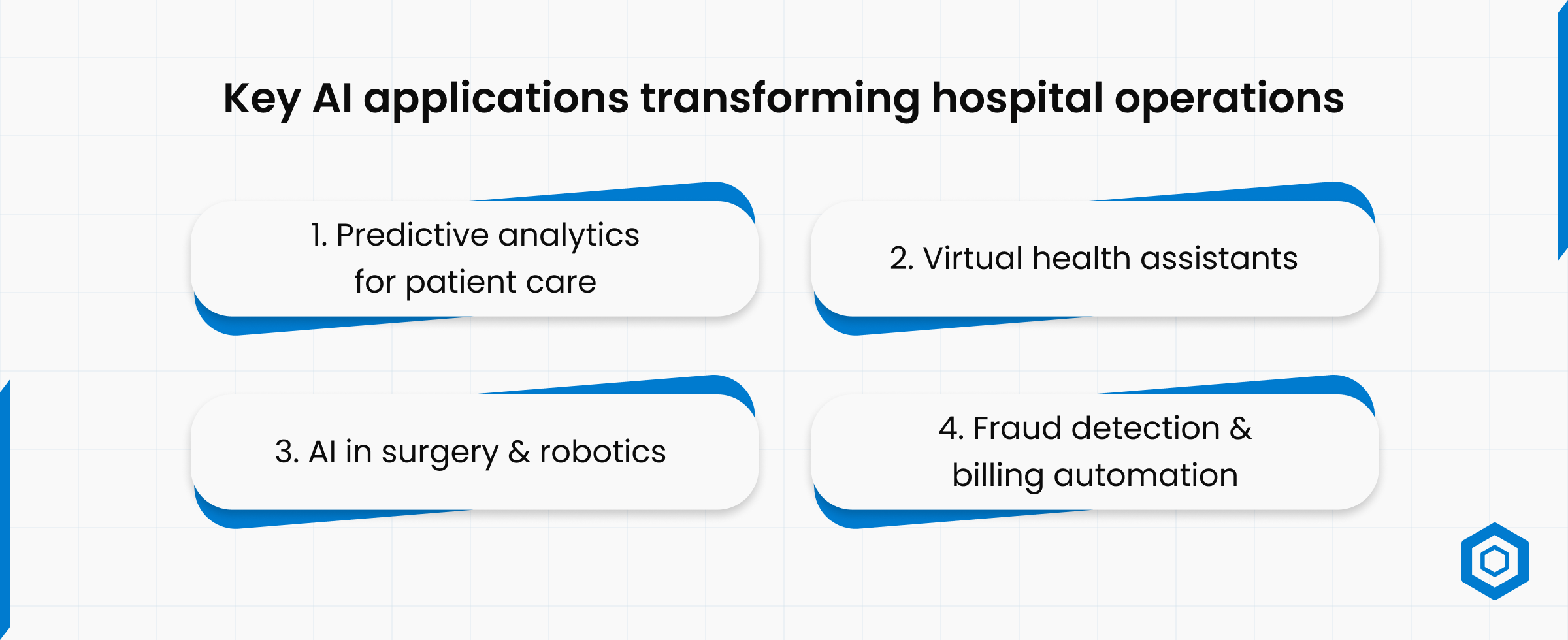
Healthcare is an ever-advancing industry with medical AI applications revolutionizing how hospitals operate, improving accuracy, efficiency, and decision-making in all departments.
1. Predictive Analytics for Patient Care
AI algorithms predict complications, readmission, and chronic illness using patient data. This helps hospitals anticipate emergencies and optimize treatment time. For proactive patient care, it’s a game-changer.
AI systems find mistakes in invoicing, catch fake insurance claims, and make billing processes more efficient. By automating revenue cycles, hospitals can reduce financial leakages and offer transparent patient billing.
We have worked with healthcare clients creating and deploying AI, and we’ve learned firsthand. Whether you need diagnoses for patient outcome prognostication or desire end-to-end automation for the hospital system, our team will exquisite carve your needs on reliable, secure systems.
We are not just here to write code at Codeflash. Having the same core values, which are teamwork, transparency, and honesty, and being well-versed in the healthcare space (they know the industry).
We speak web development, data privacy, and user experience fluently, and can’t wait to help your hospital’s AI mission.
AI is not in some future tense anymore. It is today’s powerplay weapon, particularly for hospitals of today.
From streamlining patient check-in to enhancing the accuracy of diagnoses, AI is transforming treatment innovation and delivery across all fields. And healthcare systems that are using AI in the real world are seeing real benefits beyond returns in patient satisfaction and treatment outcomes.
But AI isn’t a panacea. It is not without its problems, complications, data privacy issues, integration issues and the need for people with the right skills. But done carefully, these impediments can be solved.
And that, at its heart, is about selecting the right tech partner, focusing on health care, and one that can build the sorts of scalable, innovative systems health systems require.
AI can help hospitals in streamlining practices ranging from scheduling appointments, billing for care, and diagnosis to patient care, including resource allocation. This minimises human errors, prevents expectations from long waiting times, and enhances overall work productivity.
Thanks to strong encryption, compliance tools, and access control, AI solutions for hospital administrators can process recordings of the most sensitive patient records while maintaining privacy.
Absolutely. We create a modular and scalable product so even small hospitals can implement AI without a substantial up-front investment.
Start by identifying your biggest operational Jam. Then, consult with a healthcare software development company (like Codeflash) to see how AI can solve those specific problems.