
25 JULY
Artificial Intelligence (AI) is changing the way companies work, strategize, and develop. Ranging from streamlining the decision-making process to delivering a superior customer experience, the use of artificial intelligence in business operations is no longer a concept of the future, but one that is now used as a strategic imperative. The global artificial intelligence market size is projected to expand at a compound annual growth rate (CAGR) of 37.3% from 2023 to 2030. It is projected to reach $1,811.8 billion by 2030. As the digital revolution unfolds at an increasingly rapid pace across various sectors, AI in business management redefines company workflows, enhances productivity, and yields more brilliant results.
The relationship between artificial intelligence and management is evident in the application of AI technologies to address business problems, inform decisions, and enhance human capabilities. Through AI, it is possible to make data-driven judgments that reduce guesswork and waste, and develop personalized experiences with customers. It may be based on chatbots, predictive analytics, or robotic process automation (RPA), but one way or another, AI is deeply rooted in contemporary management approaches.
Ready to leverage AI for your business success? Email us
The answer to how AI is used in business lies in its versatility across functions. AI is used by companies across a variety of departments, including marketing, finance, operations, HR, and customer service. Artificial Intelligence-based tools are used to gain insights from large amounts of data, streamline logistics, spot fraud, or forecast customer behavior.
For example, e-commerce utilizes AI to suggest products to customers, and supply chains employ AI to forecast demand and reduce waste. In HR, the use of AI technologies automates the recruiting processes because the systems review resumes and recognise the most suitable applicants in less time than a human workforce.
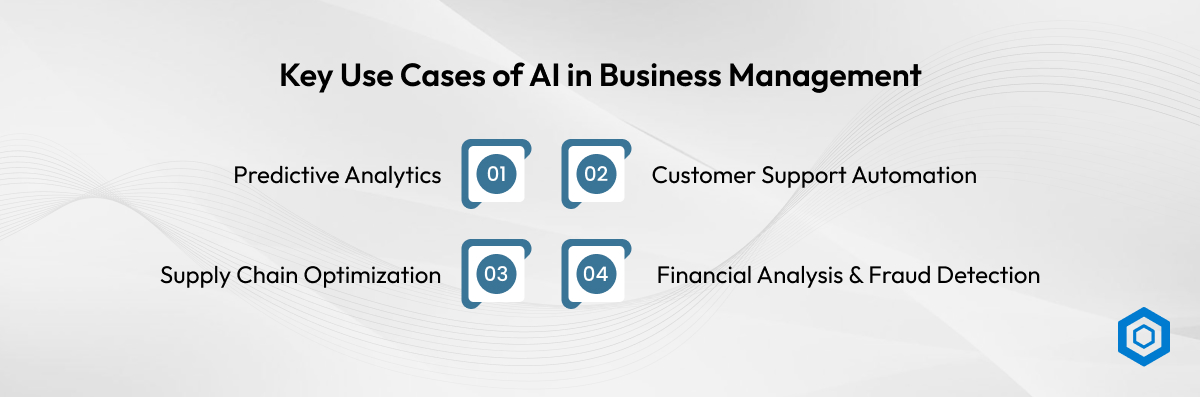
The use of AI in business spans several critical areas:
Want to see our proven results in AI-powered business transformation? Explore our portfolio
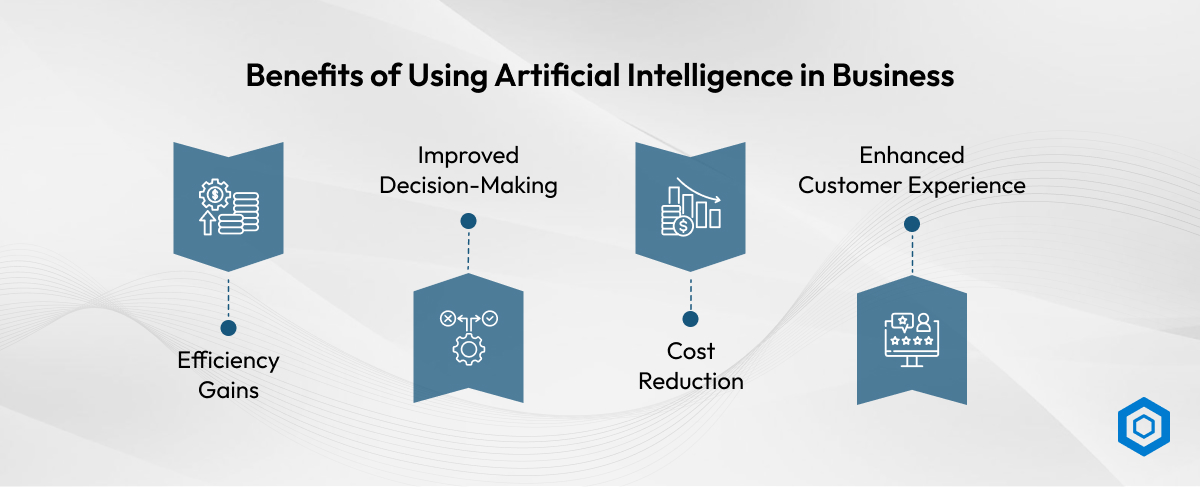
The use of artificial intelligence in business offers several compelling advantages:
Enhanced Customer Experience:
Customer loyalty and satisfaction are enhanced through personalized interactions driven by AI, whether in a retail, banking, or hospitality business.
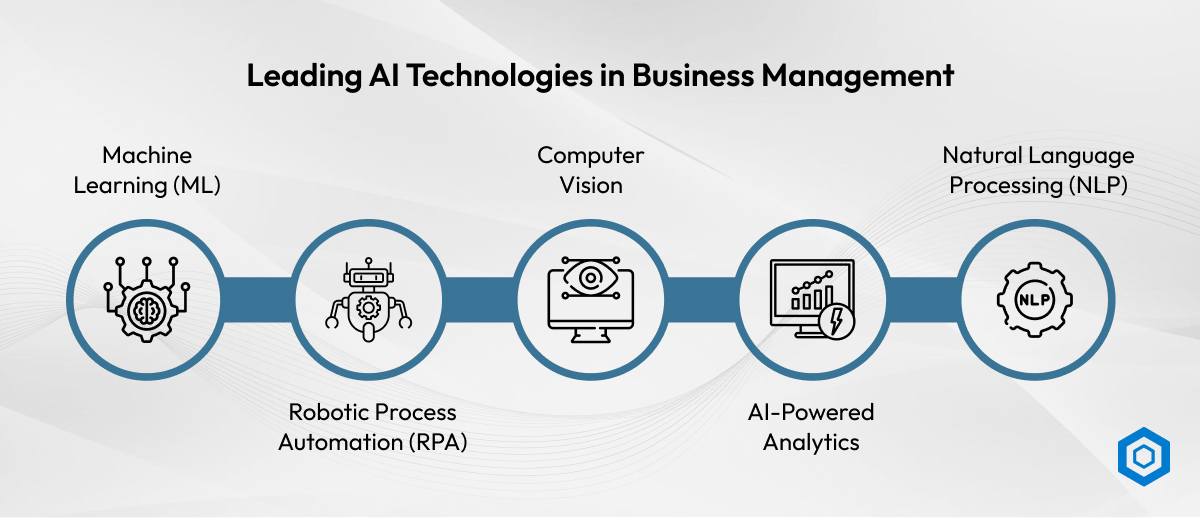
Various AI technologies fuel this transformation in business management:
As technology advances, AI in business management will only become more essential. Companies can create content automatically, generate or even test business approaches before implementation with generative AI. Data privacy and ethical concerns will be the most significant challenges, while the innovation potential is immense.
To maximize the potential of AI, leaders must make investments in digital literacy, data infrastructure, and agile workflows. Human and machine-driven intelligence will become the themes of the next generation of business excellence.
Do you have questions about integrating AI into your business model? Contact us now

AI can be applied to automate tasks, analyze large amounts of data, forecast trends, and contribute to decision-making when managing a business. It manages customer attendance, HR, finance, and operations with intelligent systems.
The advantages include increased efficiency, lower costs, better decision-making, improved customer experience, and a stronger competitive advantage. The situation is similar with AI, which enables it to respond to market trends and consumer needs more quickly.
Yes, small businesses can also benefit from AI using relatively affordable tools, such as CRM automation, chatbots, and data analytics platforms. Such tools contribute to efficient work and client interest without significant investments.
AI is not replacing jobs, but it is changing them. It replaces repetitive tasks, allowing people to focus on more creative, strategic, and emotionally charged work.
The benefits of AI can be observed in almost all industries. However, the impact of AI is particularly significant in retail, healthcare, finance, logistics, and manufacturing, where data-driven decision-making and automation can help achieve considerable efficiency.