
20 JUNE
Self-checkout has dramatically changed the retail experience for stores and their customers. As people want their purchases handled quickly, businesses are turning to RFID technology to speed up checkout. RFID technology in retail is a game-changer, particularly when integrated into self-service systems. The global RFID Market Size in terms of revenue is estimated to be worth $12.61 billion in 2025 and is poised to reach $25.24 billion by 2033, The guide explains the function of RFID in self-checkout, its benefits, its implementation, and its possible future benefits.
RFID (Radio Frequency Identification) uses electromagnetic energy to scan and record information from tags on various items. Unlike barcodes, RFID tags can be read remotely.
There are three core components in any RFID system:
Explore our portfolio to see how we’ve helped retail businesses streamline operations with custom RFID solutions.
An RFID self-checkout system automates and accelerates the purchase process. People can place all tagged items on the checkout platform, and the RFID reader will read them all at once. Everything in your shopping list is seen and summarised, and the reader is prompted to check out using their preferred method of payment.
As a result, guests spend less time at the checkout counter, errors are reduced, and office guests are satisfied. Users won’t have to track down barcodes or encounter misreads like they do in most stores’ self-checkout.
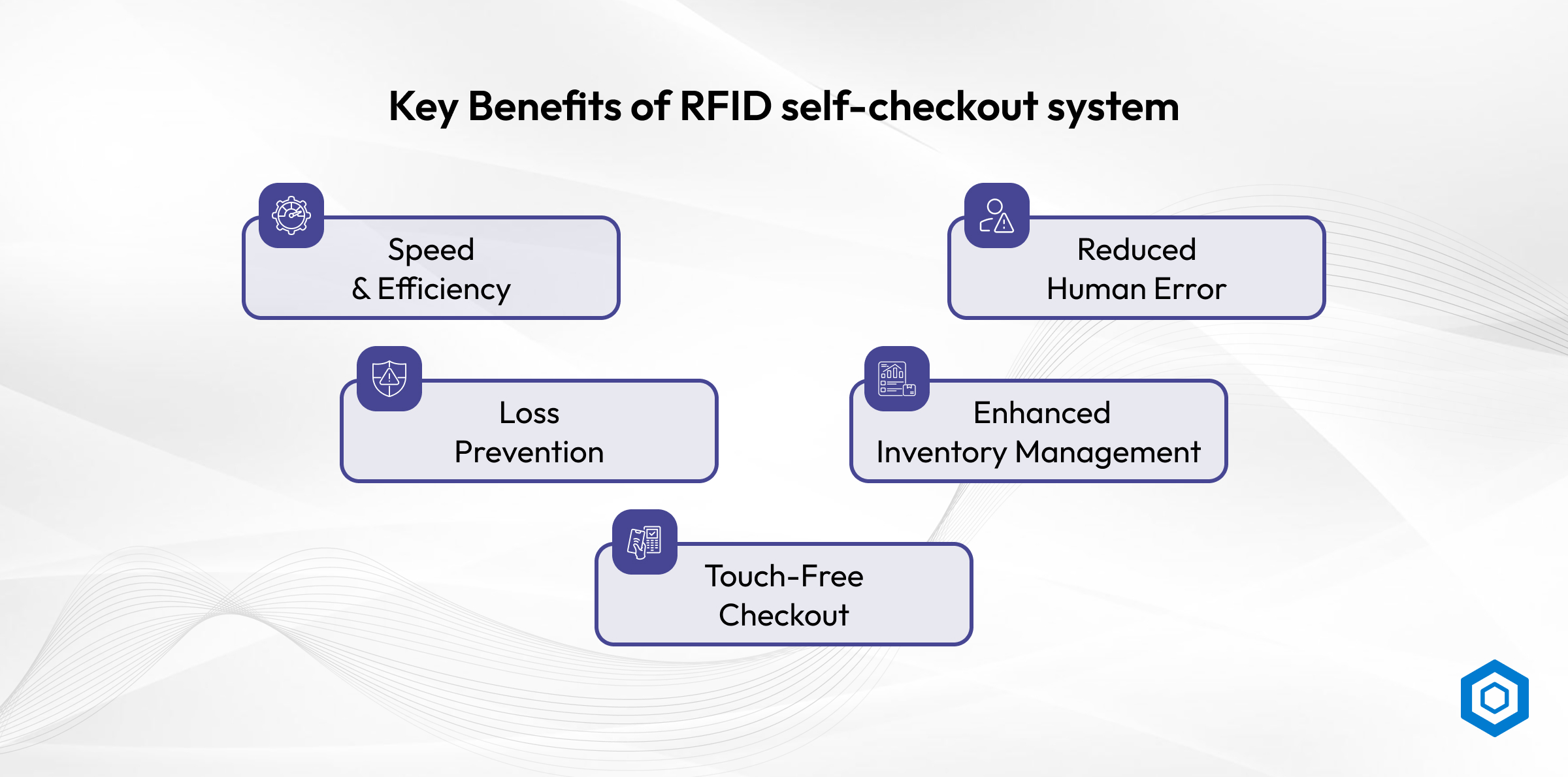
Shoppers can use RFID to be checked out much faster, since all items are scanned simultaneously. Lifting all the products simultaneously, rather than single items, makes checkout much quicker for the store’s busiest customers.
RFID means that mistakes made by cashiers in spotting products and their prices are significantly reduced.
The inventory is immediately updated when RFID is used to check out a product. As a result, you can manage your stock well, get refills automatically, and rarely see any out-of-stock situations.
RFID adds more protection to the system. Any product a customer forgets to scan or pay for will be identified at the RFID-tagged security gates near the exit.
RFID enables customers to shop without touching anything, which is preferred by many following the pandemic.
Adding RFID to a shop or store involves careful planning and proper equipment and devices.
The heart of any RFID system lies in its backend integration. RFID-based POS systems require custom solutions to handle the unique demands of product identification, billing, and inventory syncing.
To get this done effectively, many retailers turn to custom software development to tailor their RFID systems to existing operations, store layouts, and specific retail needs. This ensures seamless communication between readers, tags, and internal databases.
Email us to discuss your project needs and how we can tailor a retail solution.
Retailers like Decathlon and Uniqlo are using RFID to help customers self-check out. Uniqlo has equipped all its products with RFID tags. Once items are put in the checkout bin, the system will instantly recognize them. Consequently, customers can get out faster, saving the staff from getting involved.
Even though RFID offers many advantages, it also introduces a few problems.
To overcome these hurdles, many businesses hire retail software developers with experience in RFID integration. As a result, your company gets an easy start in another country with solutions created just for you.
RFID technology is likely to make great advancements in retail. By combining RFID with IoT and AI, it will be possible to provide personalized shopping, predict when stocks will run low, and improve the way supply chains are monitored.
Because RFID is becoming cheaper and available in many stores, you should expect it to be widely used in retail outlets. Customers often want a simple and fast checkout process.
RFID is modernizing self-checkout at stores. Compared to barcodes, RFID improves several aspects of managing stocks, wait times, system accuracy, and security. Setting up an RFID system for self-checkout involves a price and some planning, but it is worth the effort due to the better results both businesses and customers receive. If you own a store, big or small, RFID offers the chance to innovate and excel in your operations.
Contact us today for a free consultation on integrating RFID into your self-checkout systems.
An RFID self-checkout system allows customers to put all tagged goods on a scanner, which reads them all at once and skips scanning them individually.
RFID differs from barcode scanning in that it can read many items together and does not require the exact alignment needed to take scans.
RFID technology used in POS means checking out is swift, fewer errors happen, tracking stocks becomes easier, and money need not be handled physically.
Custom software development ensures that your RFID system aligns perfectly with your existing operations, providing a seamless and scalable solution.
Technology agencies, freelance sites, and firms that specialize in retail and RFID technologies can help you hire experienced developers.