

16 MAY
In the fast-paced digital world, applications are evolving beyond static functionality to deliver dynamic, personalized, and intelligent experiences. The Machine Learning Integration is one of the key forces that is helping automate the financial system and have an extensive impact on it. The global machine learning market is growing steadily, projected to reach $113.10 billion in 2025 and further grow to $503.40 billion by 2030 with a CAGR of 34.80%.
With the help of ML Models in apps, developers can create comprehensive, self-improving applications that are highly valuable to users, helping them in their day-to-day lives across various sectors, including healthcare, finance, e-commerce, and more.
ML in Software Development is no longer just a futuristic concept. Currently, it plays a crucial role as an essential component in applications’ intelligent behavior. ML algorithms enable applications to learn from data, identify patterns, make intelligent predictions, and make decisions independently. On the one hand, ML helps improve users’ experience by providing valuable suggestions, while on the other hand, it assists in enhancing organizational productivity through fraud prevention.
The conventional procedural approach in application development was based on rules; however, ML works on an adaptive rule system. This means that applications can evolve based on user behavior, new data, changing conditions critical for creating a competitive advantage, or for businesses that focus on innovation.
Want a Custom ML Strategy for Your App? Email us
Automation with machine learning (ML) is revolutionizing business operations. The use of ML within apps can also enable several highly dependent and time-consuming processes to be handled autonomously. For instance, in customer support, with the help of NLP, chatbots can answer questions and resolve disputes on their own, enhancing their performance over time.
Additionally, in the field of logistics and supply chain management, such applications of ML can help design efficient delivery routes, predict customer demand, and prevent downtime. Using information processing automation, employees eliminate mistakes, save money, and accomplish more in a day.
The integration of AI in Healthcare has led to groundbreaking advancements. Today, with the use of machine learning (ML), several symptoms of diseases can be identified by examining the impact of diseases on the human body, medical images, and personal records, as well as genetic data. For instance, apps developed for remote patient care leverage machine learning (ML) for continuous monitoring of clinical signs or to notify physicians in real-time in case of adverse events.
Additionally, healthcare apps can be tailored to a specific user’s behavior and their records, including attendance and results. It not only aims to enhance the quality of healthcare delivery but also relieves the pressure on doctors and other healthcare practitioners. A few examples of its application are diagnostic tools, virtual assistants, and medical management devices.
E-commerce platforms have seen dramatic improvements with the integration of AI in E-commerce. In this case, artificial intelligence enables companies to analyze consumer locations and preferences, providing clients with shopping experiences tailored to their needs and wants. From recommending a product to someone or possibly adjusting the price one is willing to offer for a commodity, search results and clicks are also powered by Machine learning algorithms.
Other uses of AI include chatbots and voice assistants, as well as Augmented Reality fitting rooms, where shoppers can interactively and virtually shop. Furthermore, ML models are used to identify issues in customer feedback and reviews with recurring patterns that help in upgrading products and services, as well as optimizing inventory.
Explore how we’ve transformed businesses across healthcare, finance, and e-commerce with smart, ML-integrated applications. Please view our portfolio
ML for Finance Apps has introduced more innovative ways to manage, save, and invest money. With the help of ML for financial applications, it can analyze the spending habits of a particular user and provide suggestions for financial planning, as well as detect fraud in real-time. Robo-advisors, for example, utilize machine learning (ML) to provide personalized investment strategies tailored to market trends and individual risk profiles.
Financial institutions and financial technology companies have recognized the importance of using ML in various fields, such as credit scoring, loan approval, and customer service. These apps become an excellent source of information, as they provide users with accurate details on the finances they make and the posts they encounter.
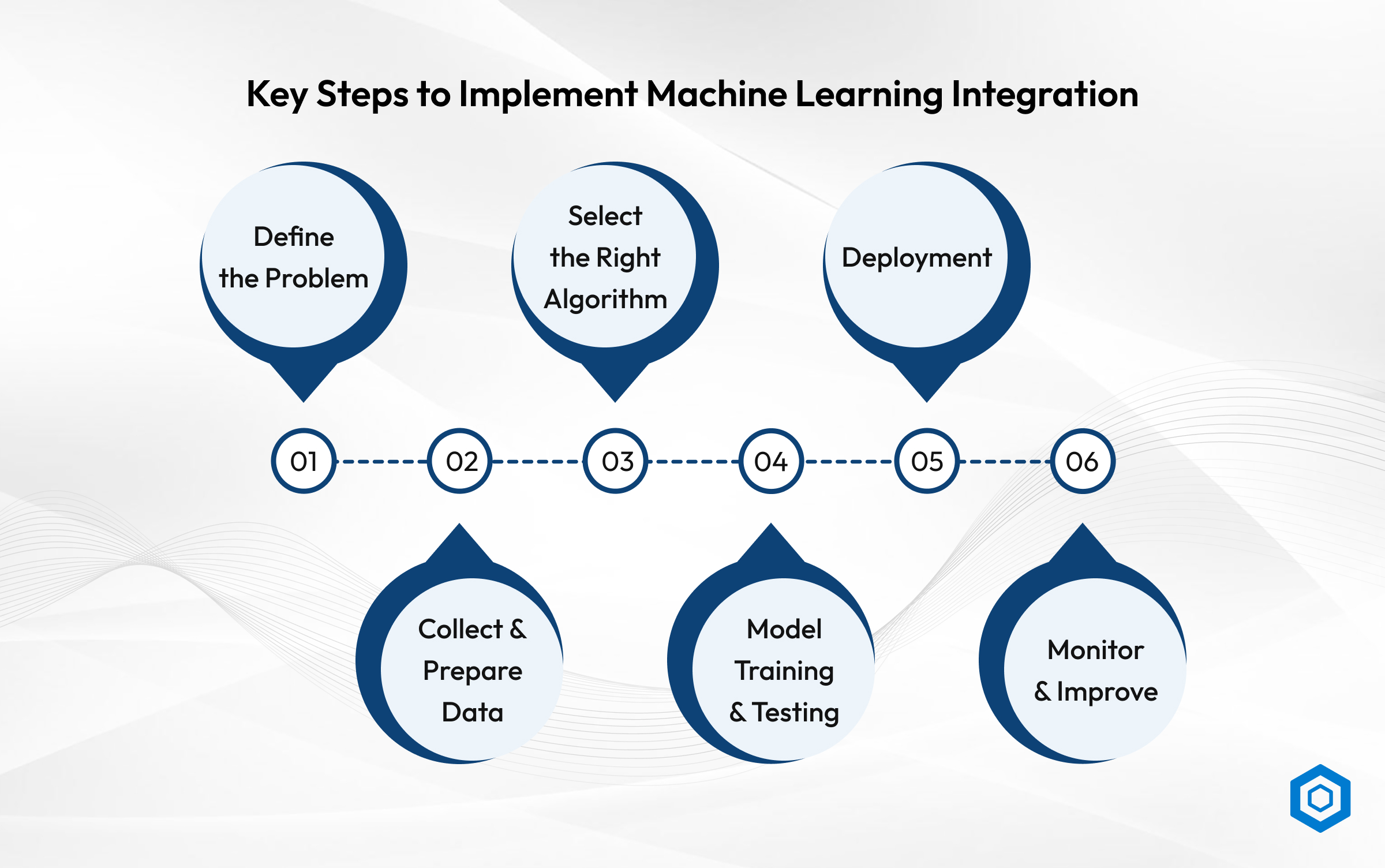
Successfully integrating machine learning (ML) into your applications requires a strategic approach. Here are the key steps:
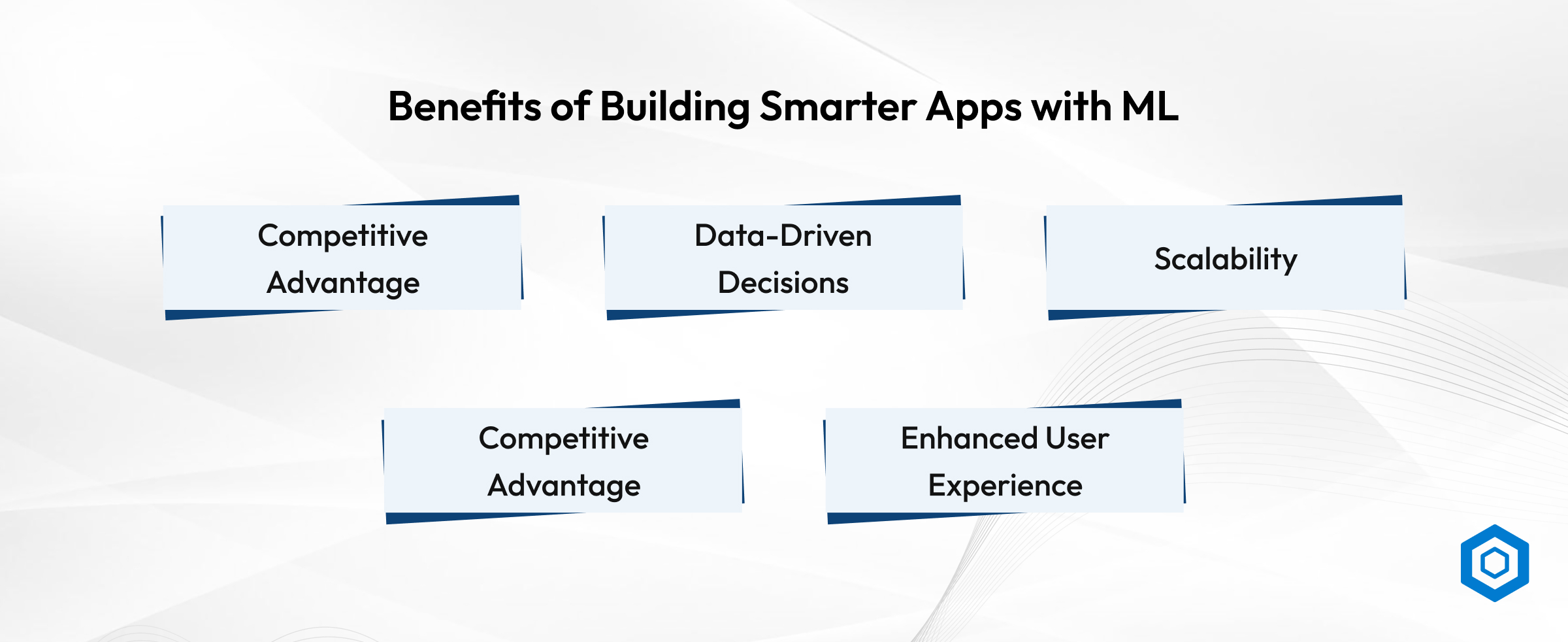
Despite the advantages, integrating ML into applications comes with challenges:
App development through machine learning integration offers multiple opportunities to achieve innovation, along with improvements in automation and personalization. Better application technology, combined with advanced features, produces jointly improved results while delivering elevated user experiences across the medical, financial, and electronic commerce industries. The present integration of ML represents a process of developing solutions that adapt to users over time, while creating instantaneous, valuable insights from user data.
Contact us today to discuss how we can integrate machine learning into your next application.

The Power of ML in App Development
Automation with ML: Smarter Workflows and Processes
AI in Healthcare: Personalized and Predictive Solutions
AI in E-commerce: Enhancing Customer Experience
ML for Finance Apps: Security and Smart Insights
Key Steps to Implement Machine Learning Integration