

12 JULY
Developing a delivery app in the UAE entails considering the development cost, features, and method. Entrepreneurs always look for new and creative ways to launch successful businesses in the ever-evolving and dynamic business world. UAE Startup entrepreneurs find on-demand food delivery app development services and other On-demand logistic delivery solutions very appealing among all these choices. The swift progress of technology has led business owners to look for novel approaches to create a significant market share and generate substantial earnings.
Food and grocery businesses may place online orders based on client preferences and deliver them to their doorstep quickly and conveniently. These platforms also make it easy for users and grocery stores to interact. The UAE is an extensive analysis offering insights into business trends and projections for 2030.
Let’s Understand the UAE’s Online Food Delivery Market
In 2023, the UAE’s online food delivery market was estimated to be worth USD 1.25 billion. The UAE Online Food Delivery Market is anticipated to grow at a Compound Annual Growth Rate (CAGR) of 4.21% between 2024 and 2030, eventually reaching a valuation of USD 3.86 billion.
Delivery aggregators like Talabat and Deliveroo have led to additional expansion in the UAE market in recent years. In addition, it is anticipated that the growing number of dual-income homes, changing food preferences, and lifestyles will all contribute to the business’s growth throughout the anticipated period.
An application for food delivery usually works like this:
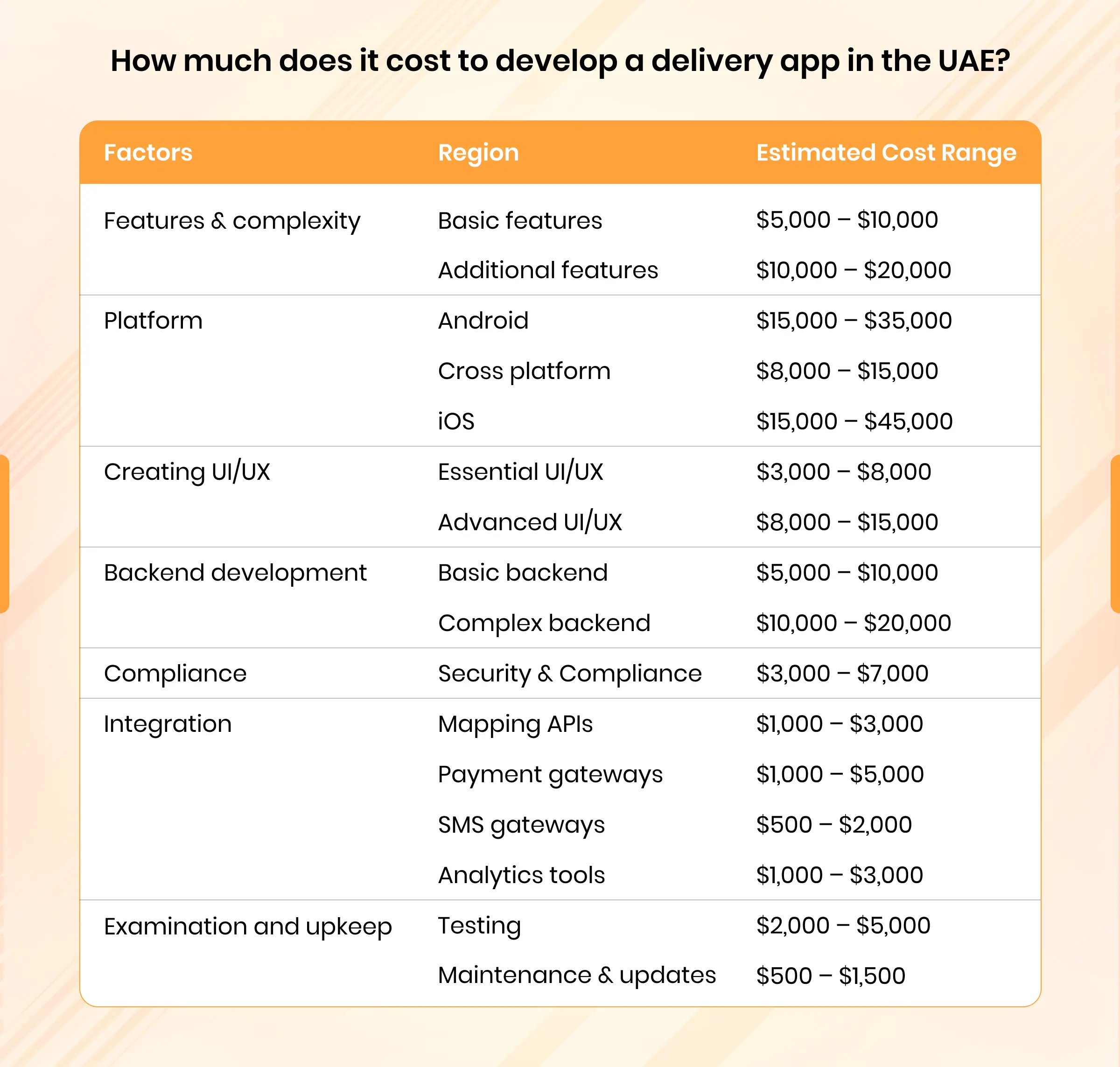
The overall on-demand delivery application development cost in the United Arab Emirates is determined by several factors in its creation. The following factors may affect the price of developing an app:
1. The application’s features and complexity
The complexity and features of the delivery application significantly impact the app development costs. Standard features include push notifications, order tracking, payment integration, and user registration. However, adding more features like real-time monitoring, the best route planning, several payment methods, and customer support will raise the development costs.
| Features |
Estimated Cost Range |
|
Basic features |
$5000-$10,000 |
|
Additional features |
$10,000-$20,000 |
2.Platform
he platforms selected, iOS, Android, or both, impact the app development cost. It is typically more expensive to create content for both platforms than to focus only on one initially. Additionally, choosing cross-platform development with frameworks like React Native or Flutter may have distinct financial consequences from native app development.
| Platform |
Estimated Cost Range |
|
Android platform development |
$15,000-$35,000 |
|
Cross-platform development |
$8,000-$15,000 |
|
iOS platform development |
$15,000-$45,000 |
3. Creating User Experiences and Interfaces
A delivery application must have an impeccable user experience (UX) and interface (UI). At the expense of increased ux/ui design expenses, investing in an aesthetically pleasing and intuitive design can increase user pleasure and engagement.
| Design Complexity |
Estimated Cost Range |
|
Essential UI/UX design |
$3000-$8000 |
|
Advanced UI/UX design |
$8,000-$15,000 |
4. Backend development for Delivery app
The mobile app backend development consists of the server, database, and API Integration, which are crucial for handling orders, user data, payments, and other essential operations. The complexity of the backend infrastructure, the need for scalability, and the integration of different services like payment gateways and mapping will all affect the development cost.
| Backend Setup Complexity | Estimated Cost Range |
Basic backend setup | $5000-$10,000 |
Complex backend setup | $10,000-$20,000 |
5. Ensuring compliance with rules and safety
It is important to prioritise financial transactions, user data protection, compliance with local regulations including UAE data protection laws, adhere to regulatory standards, and implement robust security measures. Adhering to regulatory standards and implementing security measures may require significant development expenditures.
| Security Implementation |
Estimated Cost Range |
|
Security and Compliance. |
$3000-$7000 |
6. Integration
Mobile app development costs increase when the delivery application is integrated with third-party services like analytics tools, payment gateway Integration, SMS gateways for notifications, and mapping APIs for tracking whereabouts. The overall cost will vary depending on the number and complexity of integrations required.
| Third party Integration | Estimated Cost Range |
Mapping APIs | $1000-$3000 |
Payment gateways integration | $1,000-$5,000 |
SMS gateways | $500-$2000 |
Analytics tools | $1000-$3000 |
6. Examination and upkeep
Thorough testing of the software is essential to guarantee its functionality across a range of devices and environments. Recurring delivery app development costs may also arise from the need for routine maintenance and upgrades to ensure the application runs well, fix any issues, and accommodate requests for new features
| Testing and Maintenance |
Estimated Cost Range |
|
Testing |
$2000-$5000 |
|
Maintenance and updates |
$500-$1500(Monthly) |
Developing any delivery app (food. Grocery, or Logistics ) involves the following steps:
Step 1: We will meet the customer for an initial consultation to better understand the project’s requirements. We will then complete the Industry Analysis and competitive set to meet the needs.
Step 2: Based on the specifications provided by the client, we create beautiful Wireframes UX/UI designs for the delivery of mobile apps
Step 3: After completing the wireframe, we proceed with the project’s design and send it to the assigned contact for approval. To expedite this process, we will leverage Invision, a platform that allows users to provide feedback on every aspect of the user interface through the application.
Step 4: Once the design is accepted, backend development will begin, including the Admin Panel, API, and database.
Step 5: Based on Wireframes and Backend API, our top full-stack developers start prioritising developing the hybrid or android app first because it is easier to test and release.
Step 6: After the mobile app design process, we show first Sprint to our client and ask for input on future changes or additions.
Step 7: After completing the MVP app development phase, we’ll proceed to content integration. We require content from the client at each step of the application development process.
Step 8: After the content integration is completed, we will proceed to the final testing phase, which will entail one more round of security testing.
Step 9: After all testing has been satisfactorily finished, we will provide the Android mobile app APK and begin the design process for APK distribution.
Step 10: As soon as the Android app is accepted, we will begin development on the iOS app.

So, choose the most popular delivery application in the United Arab Emirates and try to develop some unique features that can significantly benefit businesses by fulfilling the increasing need for effective delivery services and optimising operations. However, thorough planning and financial commitment are necessary to successfully navigate the delivery app development process. By partnering with a trustworthy mobile app development partner, companies can negotiate app development challenges and position themselves for long-term success in the competitive delivery market of the (UAE)United Arab Emirates.