An E-Scooter Sharing App allows on-demand rental. Use it like Lyft or Uber to schedule electric scooter trips.
These applications give consumers a proper answer and tackle specific problems they may have. What sort of issues? There are other difficulties with things like upkeep, parking, and taxi fares. That explains the success of this company concept and aligns with the latest mobile app development trends.
Our expertise in e-scooter sharing app development focuses on delivering cutting-edge on-demand app solutions that meet these needs, setting a new standard in urban mobility.
Let’s start by examining the fundamentals or the initial factors to consider while developing an app for Ride Sharing App.
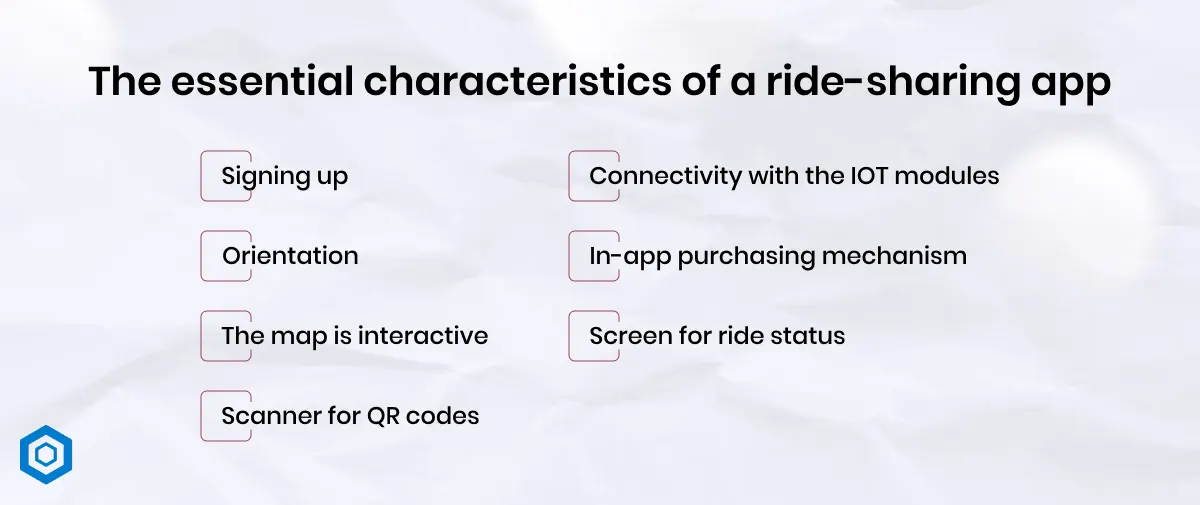
- Signing up
The registration procedure needs to be simple and speedy. In this part, requesting a phone number, email address, and verification code is typical. The consumer can proceed after this. Don’t provide usernames, passwords, or profile images because most users will complete this procedure outside and with little time. It is also possible to allow new users to verify using their social network accounts, which is a fast and dependable method. - Orientation
This isn’t just a formality. Incorrect handling of e-scooters may be dangerous and annoying. Thus, your job is to teach the consumer the fundamentals of safe riding. Nevertheless, all of the data must be clear and simple to understand. It is up to you whether or not to make it skippable. - The map is interactive
This is the central area of any app that shares scooters. Customers may locate scooters and adjacent parking spots here. Scooters are shown as clickable icons, which may be tapped to access a status panel specific to that vehicle. The controls for booking and beginning a ride are located on the status screen, along with details about the current prices and expected battery life. The interactive map also has a large, colorful button that activates the QR code scanner, as seen in the samples above. - Scanner for QR codes
Every scooter has a unique number and QR code attached to it. To unlock a scooter, the user must scan this QR code and initiate the ride using the app. Every scooter-sharing program we’ve encountered has this function so easily accessible on the dynamic map: the entire process shouldn’t take more than a few seconds.If the customer’s camera breaks or the scanner malfunctions, always provide the opportunity to input the code manually. Things take place.
- Connectivity with the Internet of Things modules
The Internet of Things is referred to as IoT. Every scooter should ideally have several sensors installed to monitor its position and condition, such as GPS and GSM modules. These sensors make operating the car with a single screen tap possible. It’s also a crucial requirement for safety, as the system will automatically lock the scooter and alert the maintenance unit if something is wrong. - In-app purchasing mechanism
When it comes to electric scooter sharing, things operate differently than they do with traditional checkout. Request the customer’s payment information when accessing the electric scooter app. Following each trip, the system will automatically charge their account based on the time that has passed.Encrypt all data before it leaves the phone using a technique that can only be decrypted with the corresponding private key saved on the recipient’s device. This is important since there is a lot of sensitive information involved.
- Screen for ride status
The interactive map changes to the ride status page after the ride has begun. This is where you may lock or park the scooter, keep track of the amount of time that has passed, and locate the closest parking spots. Customers can leave the scooter unattended by locking it (although they will still be charged for the downtime minutes). However, parking indicates that the ride is coming to an end.
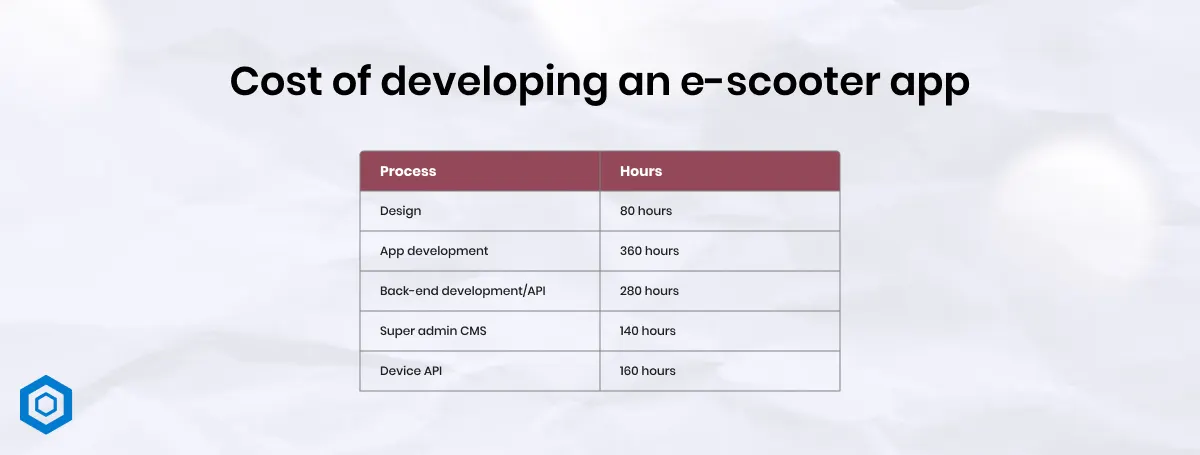
Let’s start by examining how long the C24 example’s e-scooter app development takes:
| Design | 80 hours |
| App development | 360 hours |
| Back-end development/API | 280 hours |
| Super admin CMS | 140 hours |
| Device API | 160 hours |
Thus, our experts spent 1020 hours developing the C24 e-scooter app. Assuming you requested a development from the US ($75/h) and Ukraine ($40/h), let’s use the total hours as an average.
While offshore development from Ukraine costs only $40,800, creating an e-scooter app from the US would cost you around $76,800.
The electric scooter app functions like other ride-sharing apps. Consequently, the following are the e-scooter app’s primary features:
Use the platform’s download page to obtain the app.
Access the application by entering your username and password to establish your profile.
- Find the locations of the scooters that are nearby.
- Find specific details about the scooter, such as the e-bike model and battery life.
- Utilize the map to unlock the subscription and travel to the designated location.
- Use the app to scan the QR code to get the ride.
- You have to log in before you can use the app for ride-sharing.
In conclusion, developing a smartphone app for E-Scooter Sharing App gives you access to the growing market for accessible urban transportation. Businesses creating a successful app should consider important factors like the increasing demand and popularity of e-scooters. Working with knowledgeable app developers can help add necessary features like safe payment options, user-friendly interfaces, and real-time scooter monitoring.
In addition to drawing in customers, these elements make money through advertising or leasing fees. In addition, ensuring scalability, building safety protocols, and offering rewards for user engagement all contribute to the app’s success. By using this alluring potential, businesses may meet the growing need for e-scooter solutions and increase revenues.