
22 SEPTEMBER
Information targeted at the area just next door is referred to as hyperlocal delivery. In a nutshell, it is what is going on in the neighbourhood. Hyperlocal news, forecasts, and deliveries provide information relevant to a locality.
A business concept known as a hyperlocal delivery model rapidly satisfies local customer wants. Through local retailers and a digital platform, goods and services are delivered, including prescription drugs, alcohol, groceries, meals, and drinks.
hyperlocal delivery, unlike e-commerce, guarantees same-day delivery within a few hours or minutes. This is a hyperlocal delivery service’s key differentiator from the competition.
Imagine you wish to get fresh goods using a hyperlocal delivery app (like Dunzo, Instamart, or Swiggy). The app takes your order and sends the information to the delivery person and the hyperlocal shop. Your goods are now picked up by the delivery person from the shop, who then brings them to you in 15 to 20 minutes. This is the method of hyperlocal delivery.
Now that you are familiar with this concept, let’s examine a few characteristics of a hyperlocal company.
Due to lifestyle changes, urbanization, and more tech-savvy generations, hyperlocal delivery will experience a massive increase in customers and the retail market. Hyperlocal will fulfil the consumer’s need to make everything accessible with a single click.
According to projections, the worldwide market for hyperlocal delivery services would rise at a CAGR of 14.9% from 2021 to 2030, from $1,714.60 billion in 2020 to $5,188.60 billion in 2030. (Allied Market Research)
The information points to a significant increase in the market during the prediction period.
A hyperlocal approach uses the already-existing infrastructure of the local market and technology to close the gap between customers and retail providers. Order management and delivery are made simple by creating an ecosystem that connects customers, aggregators, and suppliers in one location.
Online retailers form alliances with regional suppliers and couriers to guarantee prompt delivery in a hyperlocal business strategy. Because it guarantees speedy and easy delivery to the customer, hyperlocal delivery has become an essential choice for delivering goods and services.
Generally speaking, three supply chain models are used by hyperlocal enterprises.-
In this strategy, hyperlocal enterprises can make their items or buy directly from nearby stores to build inventory. After an order is placed, local businesses do not need to become involved because there is already inventory to complete those orders. However, enterprises find that keeping track of and maintaining merchandise to meet client expectations can be difficult.
A hyperlocal company is a middleman in the aggregator or zero-inventory model and markets the products and services under its brand. The company works with merchants and delivery services to efficiently deliver the items to the clients.
Take Airbnb’s aggregator approach, for instance. When a consumer uses Airbnb to make a hotel reservation, it links them to the hotel under its brand. However, Airbnb is secretly working with such hotels or eateries to offer the service to clients through its platform.
The inventory model and the aggregator model are combined in this model. Businesses might choose a hybrid approach based on their convenience and flexibility. A hybrid model may be tailored to the target audience’s needs and offers the advantages of both the inventory and aggregator models.
Being hyperlocal and focusing on the local economy offers several advantages. Here is a list of a few of them:
A hyperlocal firm may contribute to developing a sustainable environment, which more and more companies are focused on. Due to its narrow regional emphasis and less need for extensive travel, it lessens carbon footprints.
The market situation tends to make the affluent richer and the poor poorer due to globalization. Going local can prevent a weak rural and regional economy from developing. A hyperlocal business aspires to support neighborhood shops and brands, rural businesses, and every type of business, assisting in its expansion and success.
Businesses may oversee and manage the whole market in one location using a single platform, such as an app, a website, or a cloud-based service. Retailers and neighborhood businesses may quickly become hyperlocal, increasing their exposure and business development.
A hyperlocal model ensures that producers receive what they are due without seeing their prices rise by cutting out the intermediaries and connecting customers and producers directly. Going hyperlocal can help prevent inflation since the customer deals now with the manufacturer, ensuring that both parties are paid fairly for their goods.
If you use an app to order food, the app could display all the processes going on, such as “your order is being prepared,” “the delivery agent is on its way,” “your order is picked,” and “your order is delivered.” This kind of openness is what a hyperlocal delivery model offers, fostering trust among customers and other partners while fostering growth and demand.
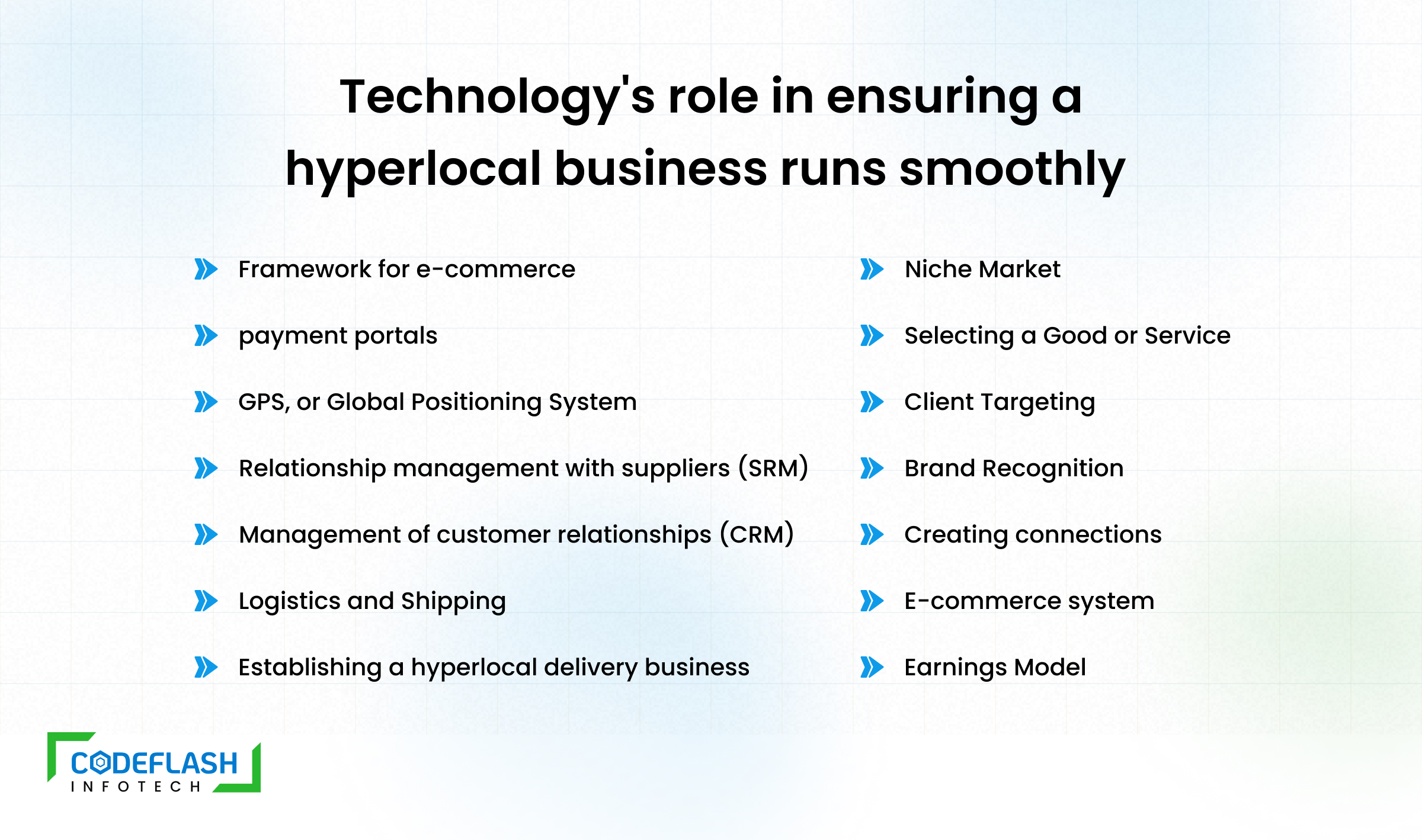
A thorough infrastructure is needed to build a hyperlocal business model, including relationships with vendors and merchants and connections to the technology enabling the necessary hyperlocal delivery procedure. A hyperlocal marketplace’s reliance on technology strengthens the whole business strategy. The tools that create a working hyperlocal marketplace include:

Customer experience and changing lifestyles have contributed to the hyperlocal market’s growth, which will continue to increase. People frequently select services that are rapid and easy, especially post-covid. This hyperlocal delivery business model Guide enables consumers to move towards accessible possibilities due to the rise of technology and the internet. Businesses may profit from client experience and loyalty with hyperlocal models.
Even industries other than retail, including food delivery app solutions, alcohol, cosmetics, and clothes, have room to grow hyperlocal. Additionally, the economy would see massive development if rural e-commerce became hyperlocal.
If Artificial Intelligence (AI), drones, and robots are used to do hyperlocal delivery, the face of these deliveries might be dramatically altered by the advancement of technology.
The customer’s convenience has made the hyperlocal delivery model competitive, and with the proper skills and resources, you may create your own prosperous hyperlocal delivery company.
What does a business model for hyperlocal delivery mean?
Features of a Business Model for Hyperlocal Delivery:
Why should investors choose hyperlocal models?
Running a hyperlocal delivery company using several supply chain models:
A Hyperlocal Business Model’s Advantages
Assisting neighborhood businesses
Technology’s role in ensuring a hyperlocal business runs smoothly